ICD-10 Codes for Anxiety Disorders: F41.1, F41.9 and Related Codes
September 24, 2026
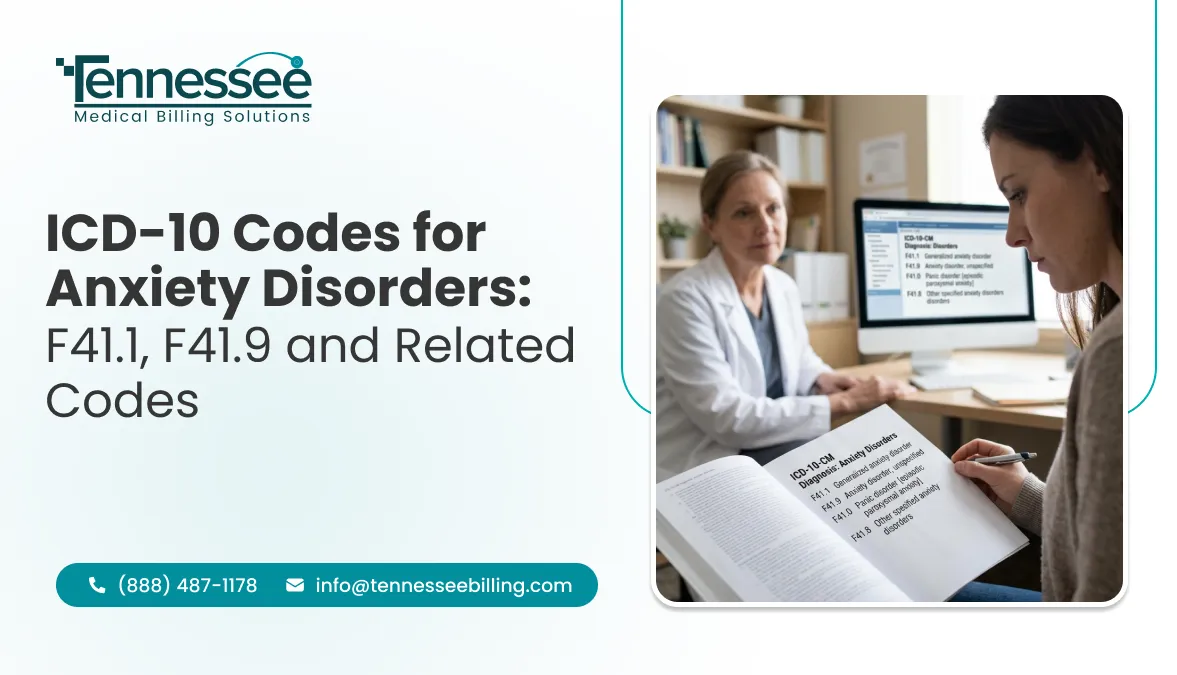
A patient can tell a provider, “I’ve been feeling anxious,” without that statement telling the whole coding story.
It could be generalized anxiety disorder, an unspecified anxiety disorder, panic disorder, an adjustment disorder with anxiety or some other diagnosis. The ICD-10-CM code should be driven by the diagnosis documented in the medical record, not just the symptom.
F41.1 and F41.9 are the codes that create the most confusion for many practices. F41.1 is generalized anxiety disorder and F41.9 is anxiety disorder, unspecified. The distinction is important where the claim requires an accurate reflection of the provider’s assessment.
This guide will cover the most common ICD-10 anxiety codes, documentation considerations, related CPT coding, modifier use, common claim problems, and what practices should check when an anxiety-related claim is denied.
There is not one ICD-10-CM code that applies to every patient who experiences anxiety.
The appropriate code depends on what the provider diagnosed. A patient may have generalized anxiety disorder, panic disorder, social anxiety, adjustment disorder with anxiety, or an anxiety disorder that has not yet been further specified.
Two codes commonly discussed are:
|
A
ICD-10-CM Code
F41.1
Generalized anxiety disorder
|
VS
|
B
ICD-10-CM Code
F41.9
Anxiety disorder, unspecified
|
These codes may sound similar, but they communicate different levels of diagnostic specificity.
If the provider documents generalized anxiety disorder, F41.1 reflects that diagnosis. If the provider documents an anxiety disorder without identifying a more specific type, F41.9 may be appropriate. The chart should drive that distinction.
F41.1 is assigned to generalized anxiety disorder, commonly called GAD.
A person with Generalized Anxiety Disorder (GAD) may tell you that they constantly worry about a variety of issues, including their daily responsibilities, work, money, family, and health. The clinical note may also include difficulties in concentrating, restlessness, irritability, muscle tension or sleep disturbance.
Those symptoms help describe the patient’s condition, but they do not allow a coder to independently diagnose GAD. The important part of the record is the provider’s assessment. For example, a follow-up note might state: Generalized anxiety disorder; symptoms improved with current treatment.
when the healthcare provider documents GAD, F41.1 matches with that diagnosis. Pulling F41.9 from an older problem list instead would make the claim less specific than the current assessment.
F41.9 represents anxiety disorder, unspecified.
When a provider has recognized an anxiety disorder but has not recorded a more precise kind, it may be suitable. This may be during an initial evaluation or while the provider is still working through overlapping symptoms and differential diagnoses.
For the word “anxiety,” F41.9 is not a general-purpose code because of this. If the medical record clearly defines GAD or panic disorder or some other defined condition, the more specific diagnosis should be considered instead. In contrast, a coder should not be making the diagnoses more specific than the provider’s documentation supports.
A useful way to approach the distinction is to ask:
What diagnosis did the provider actually establish for this encounter?
That question keeps code selection tied to the medical record instead of assumptions based on symptoms.
The difference becomes easier to see when the documentation is placed side by side.
| Documentation | Code to Review | Why |
| Provider documents generalized anxiety disorder | F41.1 | A specific anxiety disorder has been identified |
| Provider documents anxiety disorder, unspecified | F41.9 | The type of anxiety disorder has not been specified |
| Patient reports feeling anxious, but no anxiety disorder is diagnosed | Do not assign F41.1 solely from the symptom | A symptom does not establish the provider’s diagnosis |
| Provider documents another defined anxiety-related condition | Review the applicable code family | F41.1/F41.9 may not describe the documented condition |
For example, imagine two follow-up visits.
At the first visit, the provider documents generalized anxiety disorder and discusses the patient’s response to treatment. F41.1 would correspond with that assessment.
At the second visit, the provider documents an anxiety disorder but does not identify a specific type. F41.9 may better represent the documentation. The difference is not about which code is easier to submit. It is about whether the diagnosis on the claim matches the diagnosis in the chart.
Anxiety-related conditions extend beyond F41.1 and F41.9.
| ICD-10-CM Code | Description |
| F41.0 | Panic disorder |
| F41.1 | Generalized anxiety disorder |
| F41.3 | Other mixed anxiety disorders |
| F41.8 | Other specified anxiety disorders |
| F41.9 | Anxiety disorder, unspecified |
| F06.4 | Anxiety disorder due to known physiological condition |
| F43.22 | Adjustment disorder with anxiety |
These codes should not be treated as interchangeable options.
Anxiety symptoms can occur in a wide range of clinical situations. A patient may be anxious before an operation, have palpitations during an acute illness, have trouble sleeping after a serious diagnosis or report an increase in worry while coping with another medical problem.
None of those circumstances alone constitutes generalized anxiety disorder. The same applies for symptoms such as restlessness, concentration problems, nervousness or sleep problems. They can be relevant to the encounter but the coder should refer to the provider’s assessment before assigning an anxiety disorder
This distinction is particularly important when an EHR carries forward an old diagnosis. A current note may describe symptoms without confirming that the previous psychiatric diagnosis remains active or relevant to the encounter.
Good documentation does not have to be lengthy. It needs to make the clinical assessment understandable.
Depending on the encounter, the record may describe:
If documented, code patient with GAD claim F41.1. If the provider continues to document the condition only as an unspecified anxiety disorder, then F41.9 may be the better choice.
The objective is not to make the diagnosis sound more specific. It is to make the claim accurately represent the medical record.
ICD-10-CM and CPT answer different questions on a claim. The ICD-10-CM code describes the diagnosis, while the CPT code describes the service performed.
Behavioral health services may involve CPT codes such as:
A diagnosis code does not, by itself, make a CPT service payable. The service must also meet the applicable documentation, medical necessity, time, coverage, and payer requirements. CMS’s NCCI materials identify psychiatric diagnostic and therapeutic services within this coding area and emphasize correct reporting of services performed.
What About Modifier 25? Modifier 25 belongs in the conversation when an E/M service is reported on the same date as another procedure or service and the E/M service is significant and separately identifiable.
For example, a provider may manage a patient’s anxiety medication during an E/M encounter while another separately reportable service is also performed. Modifier 25 should not be added simply because two services appear on the same claim.
CMS specifically describes modifier 25 as applicable to a significant, separately identifiable E/M service when the circumstances support it. For behavioral health billing, the documentation should make it possible to distinguish the E/M work from the separately reported psychotherapy service when both are billed
Anxiety and E/M Visits Anxiety is often managed during an office or outpatient E/M visit rather than through psychotherapy alone. A provider may review medication effectiveness, address side effects, assess changes in symptoms, adjust treatment, or manage another condition during the same encounter.
The E/M level should represent the work actually performed. The presence of F41.1 or F41.9 does not automatically determine the E/M level. When psychotherapy and an E/M service are reported together, the documentation should support both services separately. If a modifier is required, it should be used because the coding circumstances support it not simply to bypass an edit.
This is one area where a claim review can be more useful than changing the diagnosis code. The diagnosis, CPT code, modifier, time documentation, and payer rules all need to line up
Anxiety claims can run into problems even when the underlying diagnosis is valid.
One example is a diagnosis mismatch. The provider documents generalized anxiety disorder during the current visit, but the billing system pulls F41.9 from an outdated problem list.
Another issue occurs when a claim uses an anxiety diagnosis simply because the patient reported feeling anxious. That can create a disconnect between the clinical note and the diagnosis submitted to the payer.
Behavioral health claims can also be affected by:
A denial does not automatically mean the ICD-10 code is wrong. The ERA/EOB and the actual denial reason should be reviewed before changing the diagnosis.
This is where the remittance advice becomes useful.
After a claim is processed, an ERA or paper remittance can show the reason for an adjustment. CMS explains that claim-level or line-level adjustments can include a Claim Adjustment Group Code (CAGC), Claim Adjustment Reason Code (CARC), and Remittance Advice Remark Code (RARC).
For example, a diagnosis-related adjustment may point to a mismatch between the diagnosis and the service. CMS’s code information includes CARC 11, which indicates that the diagnosis is inconsistent with the procedure. Another possible diagnosis-related message is RARC M76, which identifies a missing, incomplete, or invalid diagnosis or condition.
These codes should be treated as clues to the payer’s reason for the adjustment, not as instructions to automatically replace F41.1 with F41.9.
|
01
|
Review the ERA/EOB
|
→ |
|
02
|
Identify the CARC/RARC
|
→ |
|
03
|
Compare the Claim with the Medical Record
|
→ |
|
04
|
Check Payer Policy
|
→ |
|
05
|
Correct the Actual Problem
|
→ |
|
06
|
Resubmit or Appeal When Appropriate
|
✓ |
That approach is much safer than changing a valid diagnosis simply because a claim was denied.
They can be reported together when the provider has diagnosed both conditions and both are relevant to the encounter.
For example, a patient may have a documented anxiety disorder and a depressive disorder that the provider is actively evaluating or treating. In another case, the provider may document a different condition that better explains the patient’s symptoms.
The goal is not to add every diagnosis that appears somewhere in the chart. The claim should represent the conditions that are documented and relevant to the services reported.
If you’re also considering depression ICD-10 codes, focus intently on the provider’s language around the depressive disorder, episode, recurrence, and severity versus treating “depression” as a single interchangeable diagnosis.
Specificity helps the claim tell the same story as the medical record.
Neither code should be selected simply because it seems more convenient for billing. If the provider documents a specific anxiety disorder, the coding should reflect that documentation when supported. If the provider has not established a more specific diagnosis, an unspecified code may accurately describe the encounter.
That distinction also helps during audits and claim reviews because the diagnosis on the claim can be traced back to the provider’s assessment.
Practices should match their code reference to the date of service.
For FY2027, CMS has published the ICD-10-CM update files for patient encounters from October 1, 2026 through September 30, 2027. CMS also provides the FY2027 code tables, addenda, conversion table, and Official ICD-10-CM Coding Guidelines.
That makes the annual code-set transition a good time to review:
Avoid relying on an undated online code list when the date of service crosses into a new fiscal-year code set.
Just because you have a proper diagnosis of anxiety doesn’t mean the claim will go through without issue.
The issue may be with another part of the claim. CPT code, modifier, authorization, eligibility, place of service, documentation, payer policy or medical necessity requirements.
Let’s consider a claim where the provider wrote Generalized Anxiety Disorder and the medical record supports F41.1, but the payer sends back a diagnosis related adjustment. Changing F41.1 to F41.9 without understanding the denial will not fix the underlying problem.
Instead, review the claim line and the payer’s explanation. If the denial points to a diagnosis/procedure relationship, check whether the CPT and ICD-10-CM combination is supported. If it points to a modifier issue, review the CPT combination and applicable payer or NCCI rules. If the remittance points to missing information, correct the missing element before resubmitting.
This kind of medical billing claim review can prevent practices from making unnecessary diagnosis changes.
Anxiety-related claims often involve more than entering an ICD-10 code and sending the claim.
A practice may also need to manage eligibility verification, authorization, claim submission, payment posting, denial follow-up, payer correspondence, and accounts receivable.
That is where organized medical billing support can make the administrative side easier to manage.
A billing team should not determine the patient’s psychiatric diagnosis. That remains the provider’s responsibility. The billing process should instead make sure the diagnosis documented by the provider is carried correctly onto the claim and that other billing elements support the service being reported.
For practices looking to strengthen the administrative side of their revenue cycle, an internal resource such as Tennessee medical billing services can be linked here naturally.
A second internal-link opportunity can fit in this section with anchor text such as medical billing and coding support for healthcare practices rather than repeatedly linking the same phrase.
The difference between F41.1 and F41.9 becomes much clearer when the diagnosis is read in context. Use F41.1 when the provider has documented generalized anxiety disorder. Use F41.9 when an anxiety disorder is documented but the specific type has not been identified.
Beyond that the rest of the claim is equally deserving of attention. The ICD-10-CM diagnosis, CPT service, modifier as applicable, documentation, payer requirements, and remittance advice information should all be telling the same story. If a claim does not process as expected, begin with the actual denial or adjustment reason. Do not change a diagnosis just to make it easier to submit or pay a claim.
|
Behavioral Health Billing Support
Keep Your Anxiety Claims on Track
From diagnosis and CPT coding to claim review and denial follow-up,
accurate billing helps keep the claim aligned with the provider’s documentation. |
Need reliable billing support?
|