ICD-10 Codes for Diagnostic Assessment — Z00.8, Z03.89
September 22, 2026
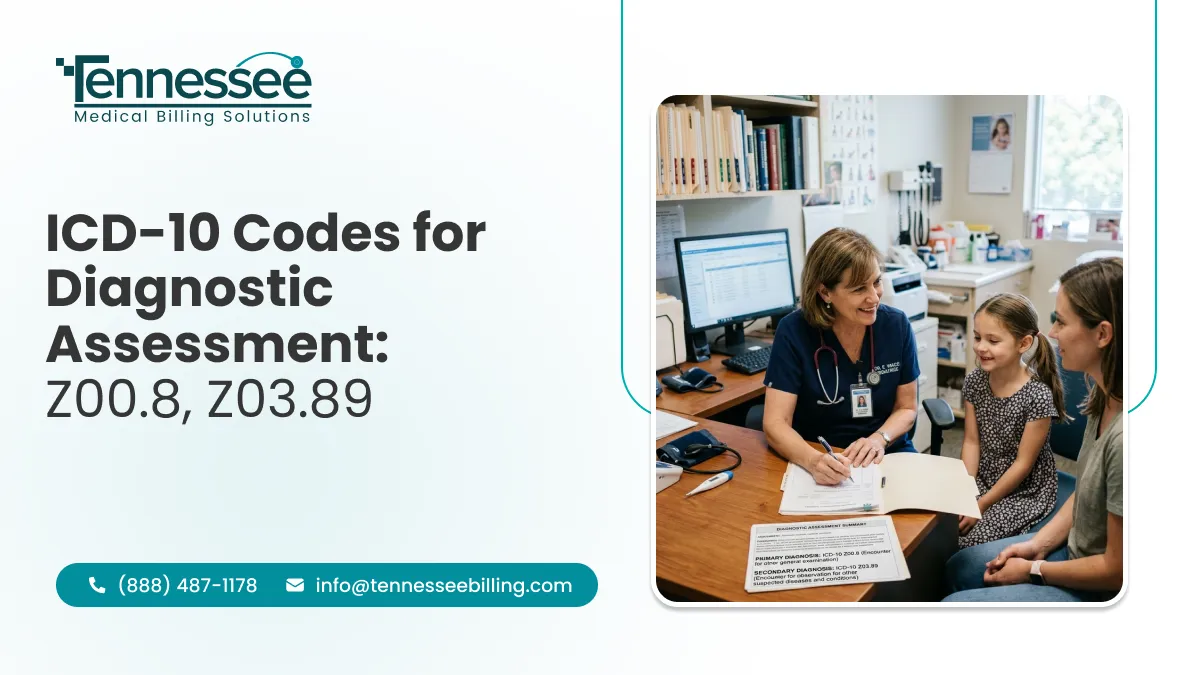
The evaluation is finished. The coding question is not.
A patient comes in for an assessment, the suspected disorder is not confirmed, and the physician closes the visit without a definitive psychiatric diagnosis.
Now comes the question: What should the encounter be coded as? That is where ICD-10 codes for Diagnostic Assessment can become confusing. Z00.8 and Z03.89 may both appear relevant, but they describe different situations. The key is not the word assessment. It is what brought the patient in and what the physician concluded.
There is no single ICD-10-CM code that applies to every diagnostic assessment.
The appropriate code depends on the encounter.
Z00.8 → Think examination
Z03.89 → Think suspected condition ruled out
Z04.6 → Think authority-requested psychiatric examination
That three-way distinction is much more useful than treating these as interchangeable “evaluation codes.”
The confusion usually starts with a simple assumption:
“No diagnosis was made, so which Z code should I use?”
That question skips the most important part.
A physician can evaluate a patient without establishing a diagnosis for several different reasons. The visit could be an examination, an evaluation of a suspected condition, a symptom-driven encounter, or a screening service.
Those situations can look similar on the schedule. They are different in the medical record.
| If the note mainly shows… | The coding question becomes… |
| A general examination | Does an examination code fit? |
| A suspected condition | Was that condition actually ruled out? |
| Symptoms | Are the symptoms the highest level of certainty? |
| A confirmed disorder | What is the documented diagnosis? |
| Screening | Was the patient being screened without signs or symptoms? |
| Authority-requested psychiatric exam | Does the record support Z04.6? |
Z00.8 describes an encounter for another general examination.
So the starting point is the nature of the examination itself. If a physician performs a general examination for a documented purpose and another, more specific examination code does not describe the encounter, Z00.8 may come into consideration.
Look for a clear explanation of:
A note that says:
Psychiatric evaluation completed. No diagnosis.
does not tell the coding team much.
A note that explains the purpose and clinical conclusion gives them something to work with.
The referral:
The patient was sent for a general psychiatric assessment.
The physician’s note:
General psychiatric examination completed. No current psychiatric disorder established during today’s evaluation.
The documentation gives the reviewer context. That still does not mean Z00.8 should be selected automatically. The full encounter must support the code.
Z00.8 should not turn into a default option for every evaluation that ends without a diagnosis.
No diagnosis ≠ automatically Z00.8
That shortcut can create coding inconsistencies across otherwise similar encounters.
Z03.89 belongs to the observation category.
It describes an encounter for observation of another suspected disease or condition that is ruled out. The code is tied to the suspected condition being evaluated and excluded. It is not simply a placeholder for an assessment where the physician did not reach a diagnosis.
Case A: Suspected condition
A referring clinician suspects a psychiatric disorder and sends the patient for evaluation. The physician investigates that concern and concludes that the suspected disorder is not established.
That encounter may raise Z03.89 for consideration, provided the coding circumstances support the observation code.
Case B: Symptoms without a confirmed disorder
A patient presents with anxiety, poor sleep, and difficulty concentrating. The physician evaluates the patient but does not establish a specific psychiatric disorder.
The fact that the disorder was not confirmed does not automatically turn the encounter into Z03.89. The symptoms or other documented reason for the visit may be more appropriate, depending on the encounter.
ICD-10-CM outpatient guidelines do not treat an uncertain diagnosis as a confirmed diagnosis. When the provider has not established a definitive diagnosis, coding follows the highest degree of certainty documented for the encounter, such as signs, symptoms, abnormal findings, or another reason for the visit.
That gives physicians an important rule of thumb:
Do not let “no diagnosis” decide the code by itself.
This is another place where clinical language and coding language can drift apart.
A psychiatrist may observe:
Those observations are part of many mental-status examinations. That does not mean the encounter automatically belongs to the Z03 observation category.
Suspected condition → evaluation → condition ruled out
That is the situation that makes Z03.89 relevant.
Simply writing “observed patient” or “psychiatric assessment performed” does not establish the same thing.
This is often the point where a clean-looking claim becomes difficult to defend.
Imagine that your patient reports:
You evaluate the patient and document that the criteria for a specific psychiatric disorder have not been established.
It should tell the reader what was actually present. Instead of ending with “No diagnosis” the assessment could state:
Patients report persistent anxiety and sleep disturbance. Evaluation does not establish a definitive anxiety disorder at this encounter. Supportive management discussed and follow-up recommended.
For outpatient encounters, an uncertain diagnosis is not coded as though it were confirmed. Symptoms and signs can become the coding focus when they represent the highest degree of certainty supported by the visit.
The reason for the referral and the physician’s final assessment are not necessarily the same thing.
A referral might say:
Rule out bipolar disorder.
That wording tells you what another clinician wanted investigated. It does not establish bipolar disorder as the final diagnosis for the outpatient encounter.
|
Referral concern
|
Physician evaluation
|
Findings
|
Final assessment
|
Coding direction
|
The best note is not the longest note. It is the one that leaves the fewest important questions unanswered.
Sometimes the problem is not the coding software. Sometimes the note leaves several possible coding paths open.
Consider: Psychiatric assessment completed. No diagnosis.
A reviewer may still need to know:
That extra uncertainty can lead to a query or claim rework.
For practices, the cost is not limited to the individual claim. Staff time gets pulled into clarification, correction, resubmission, and follow-up.
Screening and diagnostic evaluation may both happen during an assessment, but they answer different clinical questions.
“Does this person have signs of a condition that we are looking for?”
“What explains the symptoms, findings, or clinical concern already present?”
| Screening | Diagnostic evaluation |
| Generally performed when signs or symptoms of the condition are not present | Usually prompted by symptoms, findings, or a clinical concern |
| Looks for a possible condition | Investigates an existing concern |
| Often preventive or routine | Often diagnostic or problem-focused |
Patient 1: No behavioral health complaints. Completes routine depression screening.
Patient 2: Reports persistent low mood, sleep problems, and loss of interest. Receives a diagnostic psychiatric evaluation.
Both involve questions and assessment.
They do not represent the same coding situation.
Z04.6 has a much narrower description:
Encounter for general psychiatric examination, requested by authority.
The phrase requested by authority is the part that should catch your attention.
When this code is being considered, the record should make the reason for the examination clear.
For example:
General psychiatric examination performed pursuant to documented authority request.
That is very different from a routine psychiatric evaluation requested by:
The fact that an examination is psychiatric does not, by itself, point to Z04.6.
A missing diagnosis is not enough. The encounter has to fit the observation-for-suspected-condition circumstances.
“Rule out,” “suspected,” and similar uncertainty language cannot simply be treated as a confirmed outpatient diagnosis.
A patient who presents with symptoms for diagnostic evaluation is not automatically a screening encounter.
The word examination in a note is not enough to determine that Z00.8 applies.
The history may be detailed, but the coding team still needs to know what the physician concluded.
Before the claim is released, a short review can catch avoidable ambiguity.
☐ Reason for encounter is documented
☐ Referral concern is clear when relevant
☐ Symptoms and important findings are documented
☐ Physician’s final assessment is stated
☐ Confirmed diagnosis is supported by the record
☐ Uncertain diagnosis is not reported as confirmed in outpatient coding
☐ Ruled-out condition is clearly documented when an observation code is being considered
☐ Screening is distinguished from diagnostic evaluation
☐ Authority request is documented when relevant to Z04.6
☐ ICD-10-CM code matches the clinical story
☐ Current fiscal-year code set is being used
Keep this three-column view for quick reference:
| Question | Z00.8 | Z03.89 | Z04.6 |
| Main idea | General examination | Suspected condition ruled out | Psychiatric examination requested by authority |
| Is a suspected condition central? | Not necessarily | Yes | Not necessarily |
| Is it psychiatric-specific? | No | No | Yes |
| Is an authority request part of the description? | No | No | Yes |
| “No diagnosis” alone enough? | No | No | No |
ICD-10-CM code sets are updated by fiscal year, so practices should check the effective code set when maintaining coding references, templates, and internal tools.
For the current transition, FY2026 applies through September 30, 2026, while the FY2027 ICD-10-CM code set takes effect October 1, 2026.
That matters for practices reviewing old coding cheat sheets or EHR favorites around the annual code-set change.
A quick annual review can prevent staff from relying on an outdated description or code reference.
What is the ICD-10 code for a diagnostic assessment?
There is no single ICD-10-CM code for every diagnostic assessment. The code depends on the reason for the encounter, clinical findings, and final physician assessment.
Is Z00.8 used when no diagnosis is found?
Not automatically. Z00.8 is an examination code for an encounter for other general examination. A visit without a confirmed diagnosis may still require a symptom, condition, screening, or other applicable code.
When is Z03.89 appropriate?
Z03.89 describes observation for another suspected disease or condition that is ruled out. It should not be used simply because the physician did not establish a diagnosis.
Can Z03.89 be used when a patient has symptoms?
The documented symptoms and circumstances matter. In outpatient coding, when a definitive diagnosis has not been established, the highest degree of certainty supported by the encounter may be reported, including signs or symptoms.
What if the referral says “rule out” a psychiatric disorder?
A referral’s suspected diagnosis is not automatically a confirmed outpatient diagnosis. The physician’s assessment from the actual encounter should guide the coding.
What is Z04.6?
Z04.6 is for an encounter for a general psychiatric examination requested by authority. The documentation should support that specific circumstance.
A schedule may call the visit a diagnostic assessment.
The billing record needs something more specific.
Those questions give the code its context. That is why the safest approach is not to search the code set for the phrase “diagnostic assessment” and stop there.
When reviewing ICD-10 codes for Diagnostic Assessment, remember one distinction:
They are not interchangeable ways to report an assessment that did not produce a diagnosis. The physician’s reason for the encounter, documented findings, and final clinical impression should lead the coding decision. When the note clearly answers why the patient came in, what was found, and what was concluded, the coding record becomes much easier to follow and there is less reason for staff to chase clarification after the claim has already left the practice.