ICD 10 Code for Cardiac Surgery: Codes, Guidelines & Billing
November 12, 2026
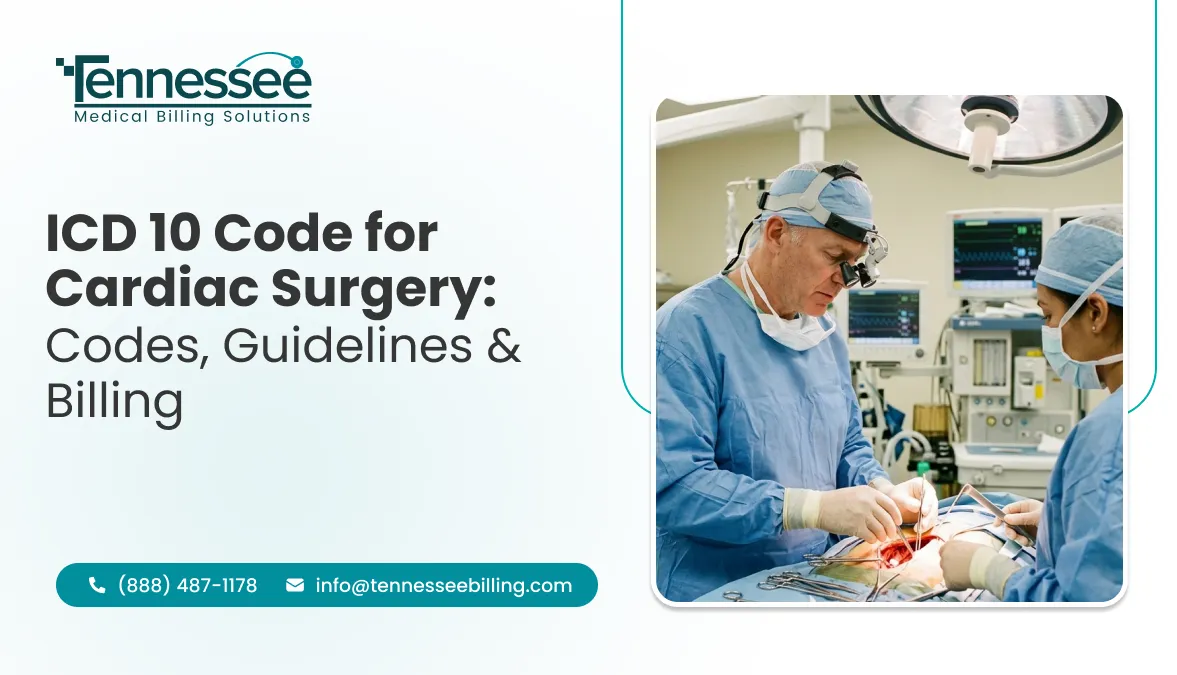
Cardiac surgery claims require different codes for the diagnosis, surgical procedure, and postoperative care. Choosing the wrong code can create documentation discrepancies and affect claim processing.
There is no single ICD-10 code for cardiac surgery. For example, Z48.812 identifies surgical aftercare following circulatory system surgery, while Z95.1 identifies the presence of an aortocoronary bypass graft.
This guide explains the relevant codes, their correct use, and the billing requirements healthcare providers should review.
The appropriate ICD-10 code depends on the reason for the encounter. A diagnosis code identifies the patient’s condition, while an aftercare or status code describes a different aspect of treatment. Hospital inpatient procedures require ICD-10-PCS codes rather than ICD-10-CM diagnosis codes to identify the operation.
A patient attending for regular follow up after CABG may be coded with Z48.812. If they have a current bypass graft, then Z95.1 may also be used. Neither of these codes will provide information about the bypass procedure that was carried out during their inpatient admission.
| ICD-10-CM Code | Description | Coding Application |
|---|---|---|
| Z48.812 | Encounter for surgical aftercare following surgery on the circulatory system | Appropriate postoperative surgical aftercare |
| Z95.1 | Presence of aortocoronary bypass graft | Existing CABG graft status |
| Z95.2 | Presence of prosthetic heart valve | Applicable prosthetic valve status |
| Z95.3 | Presence of xenogenic heart valve | Documented xenogenic valve status |
| Z09 | Follow-up examination after completed treatment for conditions other than malignant neoplasm | Qualifying follow-up after treatment |
| I25.10 | Atherosclerotic heart disease of native coronary artery without angina pectoris | Documented coronary artery disease without angina |
| I35.0 | Nonrheumatic aortic (valve) stenosis | Documented nonrheumatic aortic stenosis |
| I97.130 | Postprocedural heart failure following cardiac surgery | Documented qualifying postoperative complication |
The codes will have different uses. For example, if the patient has a history of bypass surgery they may need a status code. If they are being treated for active Coronary Artery Disease, the coding should reflect that.
The CDC ICD-10-CM classification files contain the official diagnosis codes and tabular instructions. The FY 2027 release became effective October 1, 2026.
In order to code CABG you must know how many bypass grafts there are. For ICD-10-PCS coders should know which coronary arteries were bypassed, what type of graft was used, where it was taken from and finally the technique used. This will help determine the correct code(s).
Guidelines state that when coding a coronary bypass you should use the body part character to show how many coronary artery sites were bypassed to. The qualifier will show what vessel it is being bypassed from. This will differ from some other bypass procedures.
The fact that the procedure was recorded as CABG x3 does not give us any information about the full ICD-10-PCS code. You will have to look at the operative report to see how they performed the bypasses.
Procedures with different values and/or qualifiers for the device must be coded separately according to guideline B3.6c of ICD-10-PCS. Procedures with the same applicable values for the device and qualifier can be coded using the coronary bypass guidelines.
For example if the surgeon has performed two bypasses, one using an autologous saphenous vein graft and one using an internal mammary artery, these will need to be assessed separately due to differences in the graft and vessel type used.
Before assigning an ICD-10-PCS CABG code, verify:
The procedure code must come from the applicable ICD-10-PCS tables. Assigning codes from surgical shorthand alone may overlook important details that affect the classification.
The diagnosis will determine which ICD-10-CM code to report. I25.10 may be used if atherosclerotic heart disease of native coronary arteries without angina pectoris is documented.
However, other codes may be reported if the patient had CABG and had angina, bypass graft disease or other specific coronary diseases documented. The code should be determined by what the surgeon has diagnosed and the supporting documentation.
Z95.1 may be used to report the presence of the aortocoronary bypass graft after surgery but would not be reported if there is an active coronary disease to report.
For current procedure classifications, refer to the CMS ICD-10-PCS code files and guidelines.
In Heart Valve conditions, you will need to code what is identified in the documentation as well as the procedure. If the provider documents nonrheumatic aortic stenosis then you would use I35.0. The inpatient procedure code will be determined by the procedure performed.
Valve repair and valve replacement are two different procedures. Replacement refers to replacing a body part with biological or synthetic materials. Repair refers to when a body part has been repaired by the surgeon. This doesn’t meet the definition of the more specific root operation.
The operative report must state which valve was affected, how the procedure was carried out and what material was used. You won’t have enough information if it just says aortic valve surgery.
This can be used post-operative to assign a status code in ICD-10-CM. Z95.2 is “Presence of prosthetic heart valve” and Z95.3 is “Presence of xenogeneic heart valve”.
This does not specify what the valve was replaced with during the inpatient admission, nor will this automatically assign a complication of an active prosthetic valve.
| Documented Information | Coding Consideration |
| Nonrheumatic aortic stenosis | Evaluate I35.0 |
| Prosthetic heart valve present | Evaluate Z95.2 and applicable more specific codes |
| Xenogenic heart valve present | Evaluate Z95.3 |
| Valve repair performed | Determine the supported ICD-10-PCS root operation |
| Valve replacement performed | Review device, approach, and replacement details |
| Active valve prosthesis complication | Evaluate the documented complication code |
Code selection should reflect the clinical record and current tabular instructions. Coders should not report both a general and a more specific valve status code without confirming that the classification permits the combination.
Cardiac surgery may involve three different coding systems. ICD-10-CM is diagnosis and reason for encounter coding, while ICD-10-PCS is the coding for the inpatient hospital procedure. CPT and HCPCS codes are often used for professional and many outpatient procedures.
A patient being admitted for CABG due to documented coronary artery disease will have an inpatient hospital claim using ICD-10-CM for the relevant diagnoses and ICD-10-PCS for the completed CABG. The surgeon’s professional claim will generally be CPT coded.
| Coding System | Purpose | Typical Use |
| ICD-10-CM | Diagnosis reporting | Inpatient and outpatient encounters |
| ICD-10-PCS | Hospital inpatient procedures | Inpatient facility claims |
| CPT/HCPCS | Professional and outpatient services | Physician and outpatient claims |
Selecting the wrong procedure classification can affect claim accuracy even when the diagnosis is correct. For example, an ICD-10-PCS code cannot replace the appropriate CPT code on a physician’s professional claim.
Practices handling complex surgical cases can strengthen these reviews through professional medical coding services, particularly when documentation and reporting requirements differ between facility and professional claims.
Z48.812 identifies an encounter for surgical aftercare following surgery on the circulatory system. It may apply when the visit concerns routine postoperative recovery rather than active treatment of another condition.
For example, a patient returns after CABG for incision assessment and routine recovery management. When the documentation supports surgical aftercare, Z48.812 may be appropriate. Z95.1 may also be reported when relevant to identify the patient’s bypass graft status.
The FY 2027 ICD-10-CM guidelines specifically recognize the combination of Z48.812 and Z95.1 as an example of reporting an appropriate status code with an aftercare code.
Although these encounters may occur after the same operation, their coding requirements differ. The reason for the current visit determines whether an aftercare, follow-up, or active diagnosis code applies.
Z09 describes qualifying follow-up after completed treatment. It does not replace routine surgical aftercare during recovery or coding for ongoing treatment of an active cardiac condition.
Coders should review the purpose of the visit and the provider’s documentation rather than choose a code based solely on how much time has passed since surgery.
The FY 2027 ICD-10-CM Official Guidelines explain these distinctions and provide instructions for aftercare and status code reporting.
Post-operative complications will need evidence of the link between the diagnosis and procedure. A diagnosis will not always be enough to code the complication.
For example I97.130 is used to report post-procedural heart failure. This can only be coded if there is evidence in the medical record to support the diagnosis. You will also notice in the classification that you should also report another code to indicate heart failure.
If there is no evidence to show the relationship between the CABG and heart failure then you shouldn’t assume that it was caused by the CABG. It may be appropriate to ask the provider for clarification.
Before assigning a postoperative complication code, review the following details:
These checks are important when a patient returns for active treatment rather than routine recovery. A complication encounter should not automatically receive a surgical aftercare code simply because the operation occurred recently.
Cardiac surgery coding depends on the details available in the medical record. An operative summary may identify the general procedure, but the complete report must support the specific diagnosis and procedure codes assigned.
For CABG, coders need documentation of the coronary sites, graft material, source vessels, and approach. For valve procedures, they must identify the affected valve, surgical objective, implanted material, and technique. Missing details can prevent accurate ICD-10-PCS classification.
Postoperative documentation should also explain the reason for the encounter. The provider must distinguish routine recovery from treatment of an active cardiac condition or complication.
When there is contradictory, unclear or incomplete information within the patient’s documentation, a query can be raised. The coder should determine what information influences the coding of the case.
An example would be where an operative report states that there were multiple by-pass grafts performed however there is no information to determine the origin vessel. Or a post op note states that there was a new problem but the relationship is not clear for coding complications.
Queries can be raised as necessary by the coding team to ensure that the correct codes are applied based on the fully documented clinical information. This ensures documentation integrity and will help to avoid any un-supported diagnoses being included on the claim.
Claim denials related to cardiac surgery can happen due to insufficient documentation of procedures, wrong diagnosis code chosen, and inaccurate reporting of separately billable procedures. Coding audit is necessary for determining such cases.
Some of the characters to take into account include CABG x2. The information from the report of the operation must be consulted to ensure that all the above are captured accurately.
It is important to look at the full operative report to code the correct procedure.
Z95.1 This indicates that there is Aortocoronary Bypass Graft on the patient. Should the patient be undergoing treatment for Coronary Artery Disease, then the appropriate diagnosis would be applicable. In case there is any information regarding the bypass graft, this could be recorded in this category, although it should not replace the right diagnosis.
Z48.812 is an appropriate code for any aftercare following surgery. If the clinical encounter has had an active management for a documented complication, the coders should consider what complications are appropriate to code and if they are sequenced correctly.
Some codes will have notes in the tabular section about adding further diagnoses. For example, I97.130 has a note to indicate that a further code should be added for Heart Failure. Reviewing these notes will help avoid under coding.
Claims relating to professional cardiac surgery may have edits between procedures, surgical global packages and may have modifiers required. The billing team will need to know if any extra services were provided.
Only Modifier 59 or an applicable X{EPSU} modifier should be applied if the documentation meets the criteria and the edit allows.
The CMS National Correct Coding Initiative Policy Manual provides guidance on procedure reporting, including cardiovascular surgery.
Recurring coding and payer issues can also be addressed through denial management services, which help practices investigate claim denials and identify patterns that require correction.
A pre-submission review helps billing teams confirm that the documented diagnosis, surgical procedure, and reported codes accurately reflect the encounter.
Before submitting a cardiac surgery claim, complete these checks:
For FY 2027, the ICD-10-CM release applies from October 1, 2026, through September 30, 2027. CMS’s October 2026 ICD-10-PCS release applies to inpatient discharges through March 31, 2027.
Using the applicable code set and reviewing claim documentation helps practices reduce avoidable errors before submission.
Z48.812 identifies an encounter for surgical aftercare following surgery on the circulatory system. It may apply when the provider documents appropriate routine postoperative recovery care.
Z95.1 identifies the presence of an aortocoronary bypass graft. It describes the patient’s graft status rather than the original procedure or an active cardiac diagnosis.
Yes. The ICD-10-CM guidelines specifically recognize this combination when the documentation supports both surgical aftercare and the relevant bypass graft status.
The appropriate code depends on what the claim reports. Z95.2 identifies prosthetic heart valve status, while Z95.3 identifies xenogenic heart valve status. The replacement procedure itself requires a separate procedure code according to the billing setting and operative documentation.
Not necessarily. Coronary bypass coding depends on the number of coronary artery sites bypassed and the applicable device and qualifier values. Different device values or qualifiers may require separate procedure codes.
Cardiac surgery coding requires careful review of operative details, documented diagnoses, and postoperative encounters. CABG graft configurations, valve procedures, surgical aftercare, and complications involve different coding requirements that can affect claim accuracy.
A consistent coding process helps practices identify documentation gaps, correct reporting discrepancies, and reduce avoidable billing issues.
Tennessee Billing supports healthcare providers with medical coding, claim preparation, and revenue cycle services tailored to their practice needs.

Tennessee Medical Billing is here to help you reduce denials, improve collections, and streamline your revenue cycle