CPT Codes for Therapeutic Exercise: Complete 2026 Guide
October 5, 2026
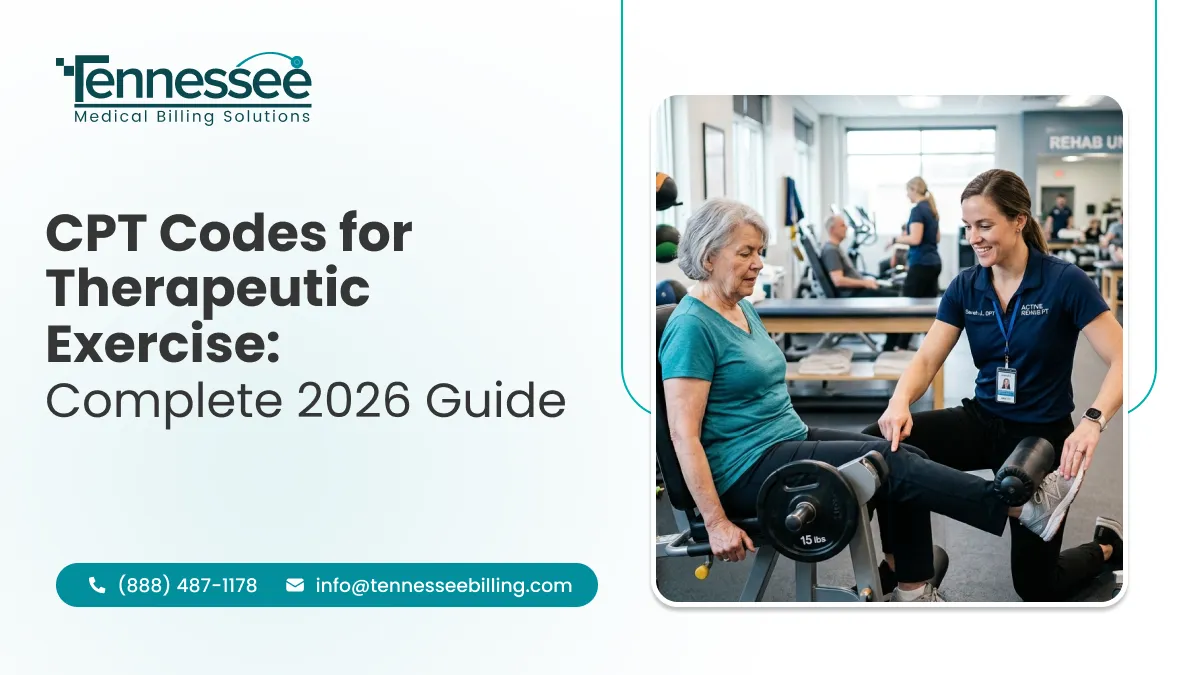
CPT 97110 may look like a simple therapy code, but most billing problems happen in the details.
A therapist may spend part of a visit working on strength, flexibility, endurance, or range of motion. In many cases, that treatment falls under CPT 97110. Still, seeing exercise in the note does not automatically make 97110 the right choice.
The reason for the exercise matters. So does the amount of time spent, the therapist’s involvement, the patient’s functional problem, and how well the note explains all of it.
That is where this guide comes in, It covers:
CPT 97110 is the CPT code that doctors use when they want to bill for therapeutic exercise. CPT 97110 indicates a procedure that helps a patient build strength and endurance range of motion or grow flexibility. CPT 97110 is reported in units of fifteen minutes.
The code may apply to exercises such as:
The exercise itself does not automatically determine whether 97110 is appropriate. The purpose of the intervention and the skilled therapy provided matter.
For example, CMS guidance identifies an exercise using a gym ball as therapeutic exercise when the purpose is to increase the patient’s strength.
|
CPT Code
97110
Therapeutic Exercise
|
What does 97110 cover?
A timed therapeutic procedure used when you provide skilled exercises to address a patient’s
strength, endurance, range of motion, or flexibility. 15-minute units
Timed service |
|
01 Intervention
What exercise was performed?
|
02 Purpose
What impairment did it address?
|
03 Response
How did the patient respond?
|
Commonly reported by physical therapists and occupational therapists
The AMA identifies 97110 as a therapy procedure using exercise and notes that the code is intended for direct therapeutic exercise interventions.
A therapy claim should show more than the fact that the patient completed exercises during the visit. It should connect the diagnosis and functional problem with the treatment provided, the time spent, and the goals outlined in the plan of care.
For a provider this means the documentation should clearly answer questions, like:
A common billing mistake is assuming that any exercise performed during therapy should automatically be reported under the same code.
Several therapy codes can appear on the same claim, but they describe different types of skilled treatment.
| CPT code | General service | When it may apply |
| 97110 | Therapeutic exercise | Exercise to improve strength, endurance, ROM, or flexibility |
| 97112 | Neuromuscular reeducation | Training aimed at improving movement, coordination, balance, posture, or neuromuscular control |
| 97530 | Therapeutic activities | Dynamic activities designed to improve functional performance |
| 97116 | Gait training | Training to improve walking or other gait-related function |
| 97140 | Manual therapy | Manual techniques performed on one or more regions |
| 97535 | Self-care/home management training | Training related to self-care, daily activities, or home management |
The difference should come from what the therapist did and why the treatment was done, not from the tools that were used.
CPT 97110 is billed according to the time spent providing the service, so the number of units should line up with the treatment minutes documented in the record. How those minutes are turned into units can vary by payer.
For Medicare outpatient therapy, the 8-minute rule is generally used to work out billable units. The total timed treatment minutes for the visit are added up first, and that total determines how many units may be reported. The table below shows how the treatment time usually lines up with the number of billable units.
CMS states that when total timed treatment time is less than 8 minutes, the service should not be billed under this methodology.
If a therapist spends 15 minutes providing therapeutic exercise and no other timed therapy services are given during the visit, that time generally supports 1 unit of CPT 97110.
When therapeutic exercise is provided for a full 30 minutes, the treatment covers two 15-minute units. In that situation, 2 units of CPT 97110 can generally be reported under Medicare’s timed-service rules.
With 36 minutes of therapeutic exercise, the total still falls within Medicare’s 23–37 minute range. That means the visit supports 2 units of CPT 97110, even though the treatment time goes beyond 30 minutes.
The calculation becomes more important when a patient receives several timed therapy services during the same visit.
For Medicare, the first step is to total the timed treatment minutes for the same discipline on the same date of service. The total determines the number of units that can be billed. The units then need to be allocated among the individual services based on the documented time for each service.
A patient receives:
Total timed treatment time = 43 minutes.
Forty-three minutes supports 3 units under the Medicare timed-unit table.
The 97110 service has 20 minutes, so it receives one unit from its first 15-minute block. The remaining billable unit allocation depends on the remaining minutes for each service. CMS examples demonstrate this type of allocation process rather than simply billing every code independently.
By doing this practice to bill four units only because the four different timed services appeared in the treatment note.
A strong 97110 note should do more than list exercises. The documentation must clearly connect the patient’s impairment to the treatment being provided, the service given, and the functional goal being worked toward. Medical coding and documentation support can also help practices review whether the documentation and coding align before claims are submitted.
This link helps show why the service is necessary and how it supports the patient’s recovery.
Useful documentation can include:
CMS guidance specifically emphasizes documentation of the skilled nature of therapy and the patient’s impairments and functional limitations.
For 97110 CMS coverage guidance also emphasizes the need to document exercises or changes to the exercise program. It is important to show how these exercises connect to the patient’s function. The documentation should also include the steps toward moving to an independent or caregiver-assisted home exercise program.
Therapeutic exercises were completed for 30 minutes. The patient tolerated the session well.
This is too general. It does not explain what the therapist worked on, why the exercises were needed, or where skilled intervention was involved.
The patient completed progressive resisted hip abduction and extension exercises to address hip weakness that was making stair use difficult. The therapist provided verbal and tactile cues to improve alignment and control, and resistance was increased as the patient showed better tolerance and movement quality.
For Medicare outpatient therapy, the plan of care should clearly outline the diagnosis, long-term goals, and how therapy will be delivered, including the type of treatment, frequency, duration, and expected amount of care.
It should also match the findings from the patient’s evaluation and include measurable goals that relate directly to the functional problems being treated.
That creates an important documentation chain:
Diagnosis → impairment → functional limitation → goal → therapeutic intervention → response/progress
For example, accurate diagnosis coding can also affect how a therapy claim is supported, as discussed in this guide to ICD-10 coding for left hip pain.
|
GP
Physical Therapy
Outpatient PT plan of care
|
GO
Occupational Therapy
Outpatient OT plan of care
|
|
CQ
Physical Therapist Assistant
Certain Medicare outpatient PT services
|
CO
Occupational Therapy Assistant
Certain Medicare outpatient OT services
|
Modifier requirements depend on the setting, discipline, provider, payer, and circumstances of the service.
GP identifies services delivered under an outpatient physical therapy plan of care when applicable to Medicare billing. CMS describes GP as the modifier for services delivered under an outpatient physical therapy plan of care.
GO identifies services delivered under an outpatient occupational therapy plan of care when applicable.
CQ applies to certain outpatient physical therapy services furnished in whole or in part by a physical therapist assistant under Medicare rules.
CO applies to certain outpatient occupational therapy services furnished in whole or in part by an occupational therapy assistant.
CMS has specific rules for determining when CQ or CO applies, including the de minimis policy and exceptions involving the final unit and two remaining units. These rules are Medicare-specific. A practice should not automatically apply Medicare modifier logic to every commercial payer.
The KX modifier is tied to Medicare’s therapy threshold policy. For CY 2026, CMS sets the threshold at $2,480 for physical therapy and speech-language pathology services combined, with a separate $2,480 threshold for occupational therapy.
Reaching that amount does not mean treatment has to stop. It means continued therapy must still be reasonable, medically necessary, and supported by the patient’s record.
The KX modifier should therefore be used only when the documentation supports ongoing skilled care. Practices should not add it automatically just because the threshold has been reached.
Using CPT 97110 correctly is only one part of a well-supported claim. The note should also make it clear why the patient needs skilled therapy and what the treatment is helping them improve. This is also part of maintaining compliant medical billing and documentation.
If several visits go by with little progress or no meaningful change in the plan of care, the payer may start to question whether continued treatment is still necessary.
That is why the documentation should reflect the patient’s current condition, response to treatment, and the clinical reason therapy needs to continue.
Not every exercise performed during therapy automatically supports 97110. The therapist should determine the appropriate CPT code based on the nature and purpose of the service.
A practice should not select the number of units first and try to make the documentation fit afterward.
The documented treatment time should support the units submitted.
Therapeutic exercise, neuromuscular reeducation, therapeutic activities, gait training, and manual therapy describe different services.
Coding should reflect the actual intervention.
A generic exercise list may fail to demonstrate why skilled therapy was necessary. Documentation should connect the intervention to the patient’s impairments and functional goals.
Medicare has rules about using the CQ and CO modifiers when therapy services are given by assistants. It’s important for practices to know exactly who did the service. Then they must follow the Medicare rules for billing.
If multiple timed services are provided, the total timed minutes determine the number of units available under Medicare’s methodology. Practices cannot simply assign one unit to every code because each service appeared in the note.
Commercial insurers may use different authorization, unit, modifier, documentation, and reimbursement policies.
Medicare guidance is an important reference, but payer-specific requirements still need to be checked before claim submission.
Many 97110 claim issues can be avoided with a careful review before submission. For practices dealing with recurring claim errors or reimbursement delays, medical billing support can help review the billing workflow before those problems become repeated denials.
The record should make it easy to understand why the patient needs therapy. Include the diagnosis, the impairment being treated, how it affects function, and the goals of care.
Explain why therapeutic exercise was selected and what the therapist is trying to improve. This helps show that the exercise is part of a skilled treatment plan, not just a routine activity.
Document the exercises performed along with the details that matter clinically, such as resistance, repetitions, cueing, progression, modifications, and how the patient responded.
Timed minutes should reflect the actual treatment provided. Since unit calculations can vary by payer and setting, accurate time documentation is especially important.
If 97110 is billed alongside codes such as 97112, 97530, 97116, or 97140, make sure each service is clearly supported in the documentation. The total number of units should also follow the payer’s timing and unit-allocation rules.
Review the modifiers that apply to the discipline and payer. If a PTA or OTA was involved in the treatment, confirm whether an assistant-related modifier is required before the claim is submitted.
Before the claim goes out, take a moment to review the payer’s rules, including insurance verification and prior authorization requirements. Make sure authorization is in place, visit or frequency limits have not been exceeded, the diagnosis meets coverage requirements, and any required modifiers or policy conditions are addressed.
When the same type of denial keeps coming back, it usually points to a larger process issue. Instead of correcting each claim one by one, look at what is causing the pattern, whether it is documentation, unit calculation, modifier use, or medical necessity.
Recurring denials often point to a recurring workflow problem.
Consider a patient recovering from a rotator cuff repair.
The patient has reduced shoulder strength and limited functional use of the affected arm. During the visit, the therapist provides progressive therapeutic exercises focused on restoring strength and range of motion.
The therapist documents:
The service is reported with 97110 when the intervention meets the code’s requirements.
The important point is that the claim does not rely on the diagnosis alone. The documentation connects the clinical problem to the specific therapeutic intervention.
The AMA uses a post-rotator-cuff-repair patient receiving direct therapeutic exercise as an example of a typical clinical situation for 97110.
|
97110
Therapeutic Exercise
Develops
Strength
Endurance Range of motion Flexibility |
97530
Therapeutic Activities
Improves
Functional performance
Dynamic movement Task performance Functional activity |
The distinction depends on the actual service performed and its purpose.
For example, a therapist may use resisted knee exercises to improve strength and report 97110. A separate functional task involving movement patterns designed to improve performance of a specific activity may support 97530 when the service meets the requirements of that code.
Do not choose between the codes simply because both involve movement.
97112 is used for neuromuscular reeducation, while 97110 focuses on therapeutic exercise.
A patient may receive both during the same visit, but the documentation should clearly distinguish the services.
For example:
When multiple timed services are billed, the practice must also follow the applicable payer’s rules for total timed minutes and unit allocation.
The AMA describes 97110 as a therapeutic procedure using exercise and provides a clinical example involving direct therapeutic exercise.
For Medicare outpatient therapy, practices also need to consider the applicable therapy coverage rules, provider qualifications, supervision requirements, setting, and payer policies.
The safest approach is to evaluate the actual service against the current CPT descriptor and the payer’s coverage and billing requirements rather than assuming that every exercise session qualifies.
What CPT code is used for therapeutic exercise?
CPT 97110 is the primary CPT code used to report therapeutic exercise to develop strength, endurance, range of motion, and flexibility. It is a timed code reported in 15-minute units.
How many minutes is one unit of CPT 97110?
CPT 97110 is reported in 15-minute units. For Medicare outpatient therapy, the total timed treatment minutes are used to determine the number of units that can be reported. Eight through 22 minutes generally supports one unit under the Medicare timed-code methodology.
Can 97110 and 97112 be billed together?
They may be reported together when both services are actually provided, separately supported, and meet the applicable coding and payer requirements. When multiple timed services are billed, total timed minutes and unit-allocation rules must also be applied.
Can 97110 and 97530 be billed on the same day?
They may be reported on the same date when both services are medically necessary, separately performed, appropriately documented, and supported under the applicable payer’s coding rules. The services should not be duplicated simply to increase the number of billable units.
What modifier is used with 97110 for physical therapy?
For Medicare, GP identifies services delivered under an outpatient physical therapy plan of care when applicable. CQ may also be required for qualifying services furnished in whole or in part by a physical therapist assistant.
What modifier is used with 97110 for occupational therapy?
For Medicare, GO identifies services delivered under an outpatient occupational therapy plan of care when applicable. CO may apply to qualifying services furnished in whole or in part by an occupational therapist assistant.
Does CPT 97110 require documentation of medical necessity?
Yes. The medical record should support the need for the therapy, the skilled nature of the intervention, and the patient’s impairments and functional limitations. CMS specifically states that therapy records must support medical necessity.
What is the 2026 Medicare KX threshold for therapy?
For CY 2026, CMS lists a $2,480 KX modifier threshold for physical therapy and speech-language pathology services combined and a separate $2,480 threshold for occupational therapy. The KX modifier indicates that continued services above the threshold are medically necessary and reasonable when supported by the record.
For most therapeutic exercise services, CPT 97110 is the central code to understand, but accurate billing requires more than selecting the right five-digit code. The documented treatment, time, skilled intervention, functional goals, medical necessity, modifiers, and payer requirements all need to line up.
For Medicare claims, practices also need to apply the applicable timed-unit methodology, assistant modifier rules, and 2026 therapy policies. CMS continues to review therapy claims for medical necessity, coding accuracy, and supporting documentation.
For providers and practice managers, the best approach is straightforward: document what you treated, why you treated it, how you provided the skilled intervention, how much time you spent, and how the treatment supports the patient’s functional goals.