ICD-10 Codes for Adjustment Disorder: F43.20–F43.29
September 28, 2026
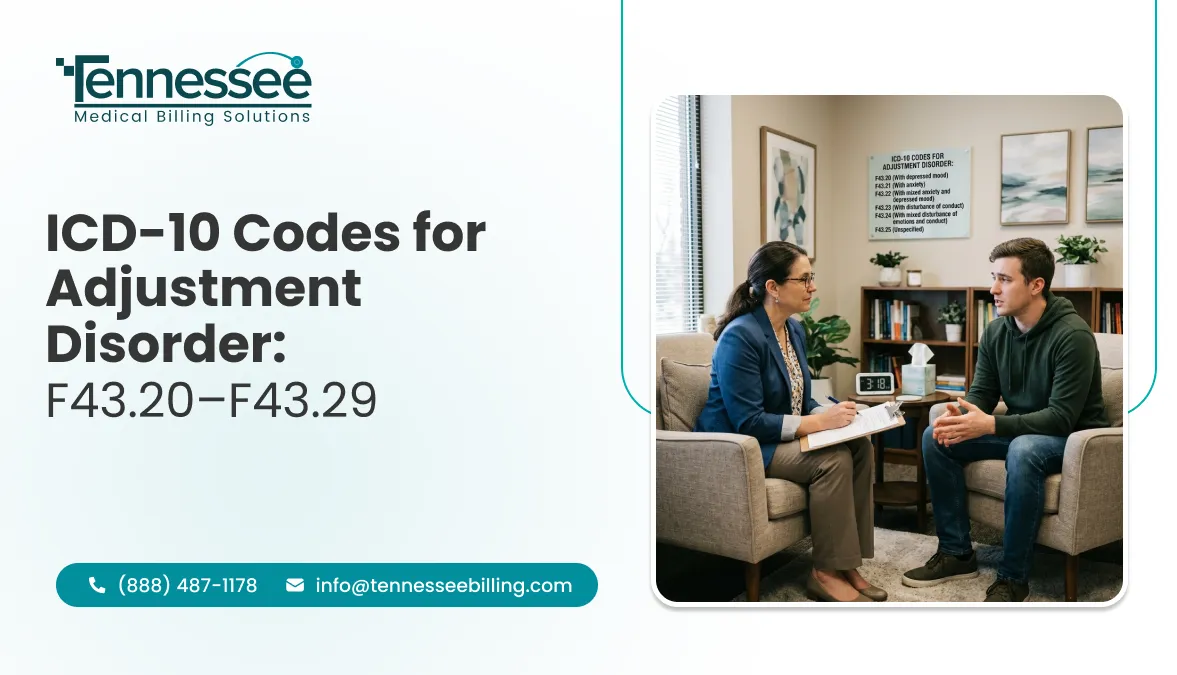
You see the anxiety, the poor sleep, the tearfulness, or the change in behavior. What is less obvious is which diagnosis belongs on the claim.
A patient may be struggling after a divorce, job loss, family problem, new medical diagnosis, or another major life change. What matters for coding is what you actually diagnose in the assessment. The ICD-10-CM code should match that documented diagnosis and the symptoms you identify.
That is where the F43.2 codes come in. Adjustment disorder is not limited to one diagnosis code. The available codes separate cases involving depressed mood, anxiety, conduct problems, mixed symptoms, and other presentations.
For a patient diagnosed with adjustment disorder with anxiety, the code is F43.22. But that code should come from your documented assessment not from the fact that the patient happens to report feeling anxious.
Here is the part worth checking before the claim goes out:
The code should match the diagnosis you document in the assessment. If your assessment states “adjustment disorder with anxiety,” use F43.22. If you diagnose adjustment disorder but do not document a specific subtype, F43.20 may be appropriate.
F43.22 is used when the provider diagnoses adjustment disorder with anxiety. For instance, a patient may report constant worry, poor sleep, and trouble concentrating after losing a job or going through another major life change.
If the assessment supports adjustment disorder with anxiety, F43.22 matches that diagnosis. But if the provider documents anxiety disorder, unspecified, the claim needs the code for that diagnosis instead. Always remember similar symptoms do not automatically mean the same ICD-10-CM code..
That is why the phrase “situational anxiety” by itself does not automatically point to F43.22. It describes what the patient is experiencing. It does not, by itself, establish the diagnosis.
The rest of the F43.2 family follows the same idea: the final characters tell you what type of adjustment disorder has been documented.
F43.20 — Adjustment disorder, unspecified
Used when adjustment disorder is diagnosed but the record does not identify a more specific presentation.
F43.21 — Adjustment disorder with depressed mood
Used when the documented diagnosis includes depressed mood.
F43.22 — Adjustment disorder with anxiety
Used when adjustment disorder with anxiety is the provider’s diagnosis.
F43.23 — Adjustment disorder with mixed anxiety and depressed mood
Used when the provider identifies both anxiety and depressed mood as part of the adjustment disorder.
F43.24 — Adjustment disorder with disturbance of conduct
Used when the diagnosed condition includes a disturbance of conduct.
F43.25 — Adjustment disorder with mixed disturbance of emotions and conduct
Used when both emotional symptoms and conduct disturbance are documented as part of the diagnosis.
F43.29 — Adjustment disorder with other symptoms
Used for another documented adjustment disorder presentation that does not fall into the more specific categories above.
You may see “situational anxiety” written in a note, especially when a patient is going through a stressful event. That wording alone does not mean the patient has adjustment disorder with anxiety. The diagnosis documented by the provider is what determines the ICD-10-CM code.
Searching for ICD 10 code F43 can be confusing because F43 represents a broader group of disorders and reactions related to stress. Adjustment disorder is only one part of that family.
Other F43 diagnoses include:
| Code | Diagnosis |
| F43.0 | Acute stress reaction |
| F43.10 | Post-traumatic stress disorder, unspecified |
| F43.11 | Post-traumatic stress disorder, acute |
| F43.12 | Post-traumatic stress disorder, chronic |
| F43.20–F43.29 | Adjustment disorder |
| F43.81 | Prolonged grief disorder |
| F43.89 | Other reactions to severe stress |
| F43.9 | Reaction to severe stress, unspecified |
That is why stopping at “F43” is not enough when preparing a claim. The additional characters identify the diagnosis being reported. The same issue comes up with F43.9. F43.9 is Reaction to severe stress, unspecified; it is not another name for adjustment disorder.
One of the easiest ways to create a coding problem is to let the billing workflow fill in gaps that were never addressed in the clinical note.
Suppose the assessment says:
Anxiety and insomnia after a patient’s divorce.
That gives the coder useful clinical information, but it does not necessarily establish whether you diagnosed:
Compare that with:
Adjustment disorder with anxiety related to recent divorce. The second assessment gives the billing team a much clearer diagnosis to work from. Good documentation does not have to be unnecessarily long. It simply needs to make the clinical conclusion understandable.
For an adjustment disorder encounter, the record may need to establish:
A coder should not manufacture a diagnosis from symptoms that the provider never diagnosed. When the documentation genuinely leaves the diagnosis unclear, a compliant provider query may be appropriate rather than guessing.
This is where adjustment disorder coding moves from diagnosis selection into actual billing.
ICD-10-CM answers the diagnosis question.
CPT describes the service performed.
So a claim might contain F43.22 as the diagnosis while using a psychotherapy or psychiatric evaluation CPT code that corresponds to the encounter.
The presence of F43.22 does not tell you which CPT belongs on the claim.
For example, two patients can both carry F43.22 while receiving completely different services. One may be having an initial psychiatric evaluation. Another may be receiving an established psychotherapy session. The diagnosis stays tied to the condition being treated; the procedure code changes with the service.
Imagine a behavioral health practice sees a patient for an established psychotherapy visit.
The assessment includes:
Adjustment disorder with anxiety — F43.22
The clinician provides the psychotherapy service documented in the note and records the time and other required details.
The billing team then has two separate questions to answer:
Those questions should not be collapsed into one.
A correct diagnosis code cannot make an incorrect CPT code payable. Likewise, selecting the right psychotherapy CPT does not make an unsupported diagnosis acceptable.
Behavioral health claims can also run into CPT-edit issues when multiple services are reported for one date of service.
For instance, Medicare NCCI rules place limits on billing 90791 or 90792 together with psychotherapy services on the same date. Before reporting both, check the applicable NCCI edits and make sure the documentation supports the services billed.
Before combining services, check the applicable NCCI edits and payer rules rather than assuming that every separately documented activity can be billed as a separate CPT service.
This is especially important for practices that use templates where evaluation and therapy components may appear together in the same encounter.
Time-based psychotherapy codes create another area where documentation and billing need to agree. If the claim reports a longer psychotherapy service, the record should support the service billed.
That does not mean filling the note with unnecessary narrative just to make it longer. The clinical documentation should accurately record what was performed and the relevant time information required for the service.
A useful internal review is simple:
What does the note say happened?
What CPT does the claim say happened?
If those two answers do not match, the claim needs another look.
This is particularly important for outpatient behavioral health.
During an initial visit, you may be considering several possibilities:
If the outpatient record says “rule out adjustment disorder” or “possible adjustment disorder,” the coder should not simply convert that wording into F43.22.
The FY2026 ICD-10-CM Official Guidelines explain that uncertain diagnoses are handled differently in outpatient and inpatient settings. For outpatient encounters, uncertain diagnoses are generally not coded as established conditions. Instead, the signs, symptoms, or other confirmed conditions documented for the encounter are coded.
Inpatient discharge coding follows a different rule for qualifying uncertain diagnoses.
That distinction can prevent a common mistake: taking an inpatient coding principle and applying it to an outpatient psychotherapy claim.
Most adjustment disorder claims do not fail because someone cannot find F43.22 in the code book. The harder problems tend to happen earlier in the workflow.
The note describes anxiety following a life event, but no adjustment disorder diagnosis is documented.
The provider has documented a specific subtype, yet the claim goes out as F43.20.
The presence of anxiety symptoms leads someone to select F41.9 even though the provider diagnosed adjustment disorder with anxiety.
The diagnosis may be correct while the billed service or time does not match the documentation.
A practice may assume that evaluation, psychotherapy, and add-on services can all be reported together simply because they occurred during the same encounter.
This is often the biggest red flag. A reviewer should be able to move from the assessment to the diagnosis code and then from the service note to the CPT without having to guess what happened.
| Clinical documentation | Coding consideration |
| “Adjustment disorder, unspecified” | F43.20 |
| “Adjustment disorder with depressed mood” | F43.21 |
| “Adjustment disorder with anxiety” | F43.22 |
| “Adjustment disorder with mixed anxiety and depressed mood” | F43.23 |
| “Adjustment disorder with disturbance of conduct” | F43.24 |
| “Adjustment disorder with mixed disturbance of emotions and conduct” | F43.25 |
| “Adjustment disorder with other symptoms” | F43.29 |
| “Anxiety after divorce,” with no adjustment disorder diagnosis | Do not independently assign F43.22 |
| “Rule out adjustment disorder with anxiety” in an outpatient encounter | Do not code F43.22 as a confirmed diagnosis |
These examples highlight an important coding principle: the diagnosis should be supported by the provider’s documentation, not reconstructed by the billing team.
Generally, no.
Adjustment disorder is diagnosed based on the clinical assessment, not a lab result. Blood work, imaging, screening tools, or other tests may be used when needed to assess the patient, but they do not by themselves determine F43.22 or another F43.2 code.
The diagnosis reported on the claim should reflect the provider’s documented assessment.
This also means a billing team should be cautious about assigning a mental health diagnosis based solely on a questionnaire score or symptom checklist.
A screening result can provide useful clinical information. It is not a substitute for the provider’s diagnosis.
The search phrase “other specified trauma and stressor related disorder ICD 10” can lead people toward the F43 family, but it should not be treated as a synonym for adjustment disorder.
When a provider documents a different trauma- and stressor-related diagnosis, the coding decision needs to follow that documented diagnosis and the current ICD-10-CM classification.
Likewise, F43.9 should not be selected simply because the chart mentions a stressful event.
The correct code depends on what the provider actually establishes.
Is F43.22 the same as F41.9?
No. F43.22 identifies adjustment disorder with anxiety, while F41.9 identifies anxiety disorder, unspecified. The provider’s documented diagnosis determines which code applies.
What is the ICD-10 code for situational anxiety?
There is no single ICD-10-CM code titled “situational anxiety.” Depending on the clinical assessment, the provider may diagnose adjustment disorder with anxiety or another anxiety-related condition.
What does F43.20 mean?
F43.20 means Adjustment Disorder, Unspecified.
What does F43.23 mean?
F43.23 means Adjustment Disorder with Mixed Anxiety and Depressed Mood.
Can F43.22 be used with psychotherapy?
Yes, when the provider has documented adjustment disorder with anxiety and the psychotherapy service is otherwise supported by the applicable coding, medical necessity, and payer requirements.
Which CPT codes can be used with an adjustment disorder diagnosis?
Depending on the service, behavioral health claims may include codes such as 90791, 90792, 90832, 90834, 90837, 90833, 90836, 90838, 90839, 90840, 90846, 90847, or 90853. The diagnosis does not determine the CPT by itself.
Can a coder assign F43.22 when the provider only documents anxiety after a stressful event?
Not simply from that information. The coder should follow the provider’s documented diagnosis and applicable outpatient coding rules rather than independently diagnosing adjustment disorder.
Is F43.9 the same as adjustment disorder?
No. F43.9 represents reaction to severe stress, unspecified. Adjustment disorder has its own F43.2 category.
The easiest way to think about ICD-10 codes for Adjustment Disorder is to start with the clinical assessment and work outward.
If the diagnosis is adjustment disorder, determine whether the documentation supports an identified subtype. If anxiety is part of the diagnosed condition, F43.22 may be the appropriate code. If the provider documents a different presentation, another F43.2 code may be more accurate.
After that, the billing review moves to a different question: what service was actually provided?
The ICD-10-CM code and CPT code have separate jobs. One identifies the condition being addressed; the other describes the service delivered. Both need to be supported by the record.
For FY2026 claims, practices should also use the applicable ICD-10-CM Official Guidelines and verify payer-specific requirements rather than relying on a generic coding rule. When documentation is incomplete, clarification is safer than guessing.