ICD-10 Code for Transaminitis: When to Use R74.01
October 8, 2026
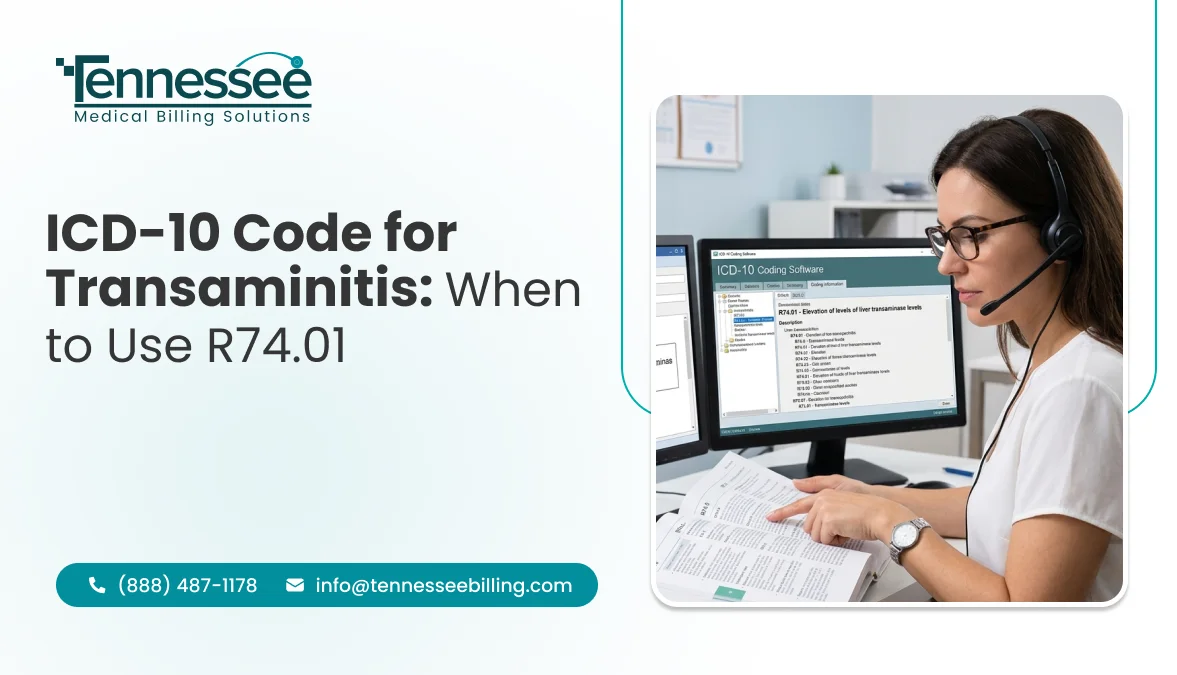
Elevated AST and ALT can look like a straightforward clinical finding, but deciding what to report on the claim can be less simple.
For FY2027, R74.01 is the ICD-10-CM code that most directly describes documented transaminitis, making it the primary ICD 10 code for transaminitis when elevated liver transaminases are the finding being evaluated. Your assessment should make clear what you found, what you are evaluating, and whether you have identified an underlying condition.
That documentation affects the diagnosis reported for the visit, how well the claim supports the services you provided, and how easily your billing team can respond if a payer questions the diagnosis.
The ICD-10-CM code most directly associated with transaminitis is R74.01, Elevation of levels of liver transaminase levels.
R74.01 belongs to the R74, Abnormal serum enzyme levels, of ICD-10-CM chapter “Symptoms, signs, and abnormal clinical and laboratory findings not elsewhere classified.” This code is used for increased liver transaminases, for example, ALT and AST.
One thing to note is that transaminitis is a clinical picture that is not a particular diagnosis according to the ICD-10-CM. Thus, the code describes the abnormal laboratory result and not the actual condition itself.
It is a significant difference, as it helps to prevent a number of the most common mistakes that a provider may make while assigning a code to a claim. For instance, if a patient has an AST or ALT increase, this does not necessarily mean that he has hepatitis, fatty liver disease, cirrhosis or any other diagnosed ailment.
You may find high transaminases during a routine physical, check medication, work up for fatigue, evaluation for abdominal pain, assessment for metabolic syndrome, or an incidental abnormal laboratory study
There are many potential reasons for this finding.
ALT is usually found in the liver, while AST is also in muscles and other organs. Therefore, increased levels do not necessarily mean that the patient has a certain liver disease. According to MedlinePlus, abnormal ALT or AST test results may occur with liver disease, but other conditions, drugs, exercise, and various other factors can also affect the results.
That creates two separate tasks for your practice:
The billing record should follow the second step, not jump ahead of the first.
When you see “transaminitis” in the assessment, ask:
Am I documenting an abnormal liver enzyme finding that I am evaluating, or have I established the condition causing it?
R74.01 can be appropriate when the medical record supports elevated liver transaminase levels and you are evaluating that finding without a confirmed underlying diagnosis that better explains the abnormality.
For example, a patient may have:
The important part is the provider’s assessment and clinical work, not simply the number appearing on a laboratory report.
The FY2027 ICD-10-CM Official Guidelines state that outpatient coding should report the diagnosis, condition, problem, or additional reasons for encounter documented in the medical record. If a diagnosis is documented as uncertain, outpatient coding does not report “probable,” “suspected,” “rule out,” or other tentative or unproven terms for the diagnosis. In such a case, coding should assign the highest level of certainty for the diagnosis based on the signs and symptoms, abnormal test results, or other reasons for the encounter.
A patient came in for a regular laboratory test, and it turned out that their ALT and AST levels are high. You examine the test results, patient’s medication and alcohol use, history of liver tests, and any existing risk factors. You type up your findings highlighting abnormal liver function tests and schedule further diagnostics to identify the cause.
At this stage, you have documented and evaluated an abnormal finding. If no definitive cause has been established, R74.01 may accurately represent the documented problem.
This is an easy place for a coding error to occur.
R74.0 should not be used if more specific child code is available. It indicates nonspecific elevation of transaminase and lactic acid dehydrogenase. Further specification is needed. R74.01 indicates elevation of liver transaminase levels while R74.02 indicates elevation of LDH.
So if your documentation supports elevated liver transaminases, the more specific R74.01 is the relevant code. Do not treat R74.0 as an interchangeable shortened version of R74.01.
R74.9 refers to an abnormal serum enzyme level of undetermined origin. Such a diagnosis does not possess the same level of specificity as R74.01 would if the record explicitly noted increased liver transaminases.
If the provider notes the abnormally identified finding as increased AST and/or ALT, the record offers more information for the coding team.
Your documentation does not need to be a long liver-disease consult every time a lab finding turns up abnormal. It does need to explain why the finding is abnormal, and what you did about it.
A strong note can address:
Document the elevated transaminases clearly.
For example:
Where clinically appropriate, record the results you reviewed and their relationship to the assessment. You do not need to copy an entire laboratory report into the assessment. Focus on the information that supports your clinical decision-making.
Explain what you think the finding represents at the current stage.
For example:
If you order additional testing, imaging, repeat laboratory work, medication review, or referral for the patient, document the reason. This is important in order to make sure that there is a logical link between the abnormal finding and the services rendered.
If your evaluation establishes a specific condition, document that diagnosis clearly. That distinction becomes important for subsequent coding.
The code itself does not automatically cause a denial. Problems usually arise when the diagnosis, documentation, service, and claim do not tell the same story.
Here are several situations worth watching.
| Potential Problem | What Happens | Better Approach |
|---|---|---|
| R74.0 submitted instead of R74.01 | The claim lacks the available specificity. | Use the appropriate specific code when documentation supports it. |
| Confirmed disease omitted | The claim continues to describe only an abnormal lab finding. | Report the established diagnosis according to coding guidelines. |
| Diagnosis not supported in the note | The claim contains a code that the documentation does not substantiate. | Make the assessment support the diagnosis reported. |
| Lab result copied without clinical assessment | Medical necessity can become difficult to establish for related services. | Document why you evaluated or managed the abnormal result. |
| Uncertain diagnosis coded as confirmed | Outpatient coding rules do not support reporting uncertain diagnoses as established. | Code the highest degree of certainty for the encounter. |
| Diagnosis does not match the service | The payer may question medical necessity or claim consistency. | Connect the diagnosis to the reason for the service. |
The fix starts with the medical record, not with changing the claim blindly.
A quick pre-billing review can catch several avoidable problems.
Before the claim goes out, confirm:
CMS states that FY2027 ICD-10-CM diagnosis codes apply to patient encounters from October 1, 2026, through September 30, 2027.
Start with the denial reason.
A transaminitis-related denial can come from several different issues, and changing R74.01 without understanding the payer’s reason can create another problem.
Check exactly what the claim reported.
Was it:
The medical record should support the diagnosis reported for the encounter. Look at the assessment, plan, laboratory results, and other documentation that supports the service.
Determine whether the payer cited:
Do not assume every denial represents a coding error.
If the original claim contained an unsupported diagnosis, do not select another diagnosis on the basis that it might pay. If the provider documented additional information that the original claim did not capture, determine whether a corrected claim or appeal is appropriate under the payers rules.
If several claims return for similar reasons, the problem may sit upstream.
Your billing team may need to review:
That turns one denial into a process improvement opportunity.
The easiest denial to prevent is the one that does not make it to the billing department in the first place. There is no need to over-complicate the process. Consistent approach to clinical documentation and coding is needed to prevent claims rejections due to insufficient documentation.
“Abnormal labs” gives the billing team little direction. “Elevated AST and ALT under evaluation” gives the coder a much clearer clinical problem.
If you reviewed the laboratory trend, investigated medications, ordered repeat testing, or pursued further evaluation, document that work when it is clinically relevant.
An abnormal ALT does not automatically establish a particular liver disease. Document the diagnosis you actually established.
A patient may present with an abnormal laboratory finding that leads to a specific diagnosis. Your documentation should reflect this progression.
Your practice should not use a static diagnosis-code list that is never reviewed. CMS publishes an annual ICD-10-CM update and identifies the effective dates.
R74.01 describes the elevation of liver transaminase levels. It does not identify the underlying cause.
The test is used to determine if there are indicators for liver damage during an assessment when increased AST and/or ALT are the documented issues and no further diagnosis has been identified.
The difference would be significant if your claim pertains to services related to diagnostic evaluation. Liver function tests are not typically used to diagnose a particular disease, and doctors evaluate ALT, AST, ALP, bilirubin in conjunction with several other indicators.
Your documentation should make that clinical reasoning visible.
A diagnosis code supports the story behind a service. A diagnosis code alone cannot confirm that the service is covered or will be paid.
For example, ordering additional diagnostic services as a result of an elevated transaminase reading requires documentation of the clinical indication of the service. The diagnosis, service, documentation, applicable coverage policy, and other claim information are considered by a payer in adjudicating the claim.
That is why a strong claim starts before charge entry.
The provider documents the problem. The coder translates the documentation. The billing team submits the claim. The payer evaluates the claim against its rules.
When a patient has elevated AST or ALT and you are still trying to figure out the underlying cause, R74.01, Elevation of levels of liver transaminase levels, is the FY2027 ICD-10-CM code you need to know.
Don’t make R74.01 a catch-all or a default code. Start with the clinical documentation. Find the abnormal finding. Document your assessment and management, and code to the highest level of certainty that the encounter supports. Reassess the diagnosis when the work up determines a more specific diagnosis.
That approach gives your coding team a cleaner record to work from and gives your billing team a stronger claim to submit.
What is the ICD-10 code for transaminitis?
The ICD-10-CM code that most directly relates to transaminitis is R74.01, Elevation of levels of liver transaminase levels. It is a billable/specific code in the FY2027 ICD-10-CM code set for encounters from October 1, 2026, through September 30, 2027.
Is R74.01 a billable ICD-10 code?
Yes. R74.01 is a billable and specific ICD-10-CM code for elevation of liver transaminase level. It should be documented by the provider and utilized depending on the encounter circumstances.
Is R74.0 the same as R74.01?
No. R74.0 is a broader, non-billable subcategory for nonspecific elevation of transaminase and LDH levels. R74.01 specifically describes elevation of liver transaminase levels, while R74.02 describes LDH elevation.
Does transaminitis mean the patient has liver disease?
Not necessarily. Elevated AST and ALT can occur for several reasons, and AST is also found in tissues outside the liver. An elevated result requires clinical interpretation and does not automatically establish a specific liver disease.
When should a provider use an underlying liver diagnosis instead of R74.01?
When the provider establishes and documents a specific condition that explains the abnormal transaminase levels, that confirmed diagnosis should guide code selection according to the applicable ICD-10-CM guidelines. R74.01 should not simply remain on every claim after the diagnostic picture becomes more specific.
Can a coder assign R74.01 from a laboratory report alone?
The provider documentation needs to support the diagnosis reported for the encounter. A coder should not independently diagnose the patient from an abnormal laboratory value. The medical record should establish the condition, problem, or reason for the encounter being coded.
What documentation supports R74.01?
Useful documentation can include the elevated AST and/or ALT, the provider’s assessment of elevated liver transaminases, relevant clinical context, review of the results, and the evaluation or management plan. The exact documentation needed depends on the encounter and services provided.
Can R74.01 prevent a denial?
No diagnosis code can guarantee payment. However, using the appropriate level of specificity and maintaining consistency between the provider note, diagnosis code, services, and payer requirements can reduce avoidable claim problems.