Aquatic Therapy CPT Code: 97113 and Related Codes for Pool-Based Therapy
October 7, 2026
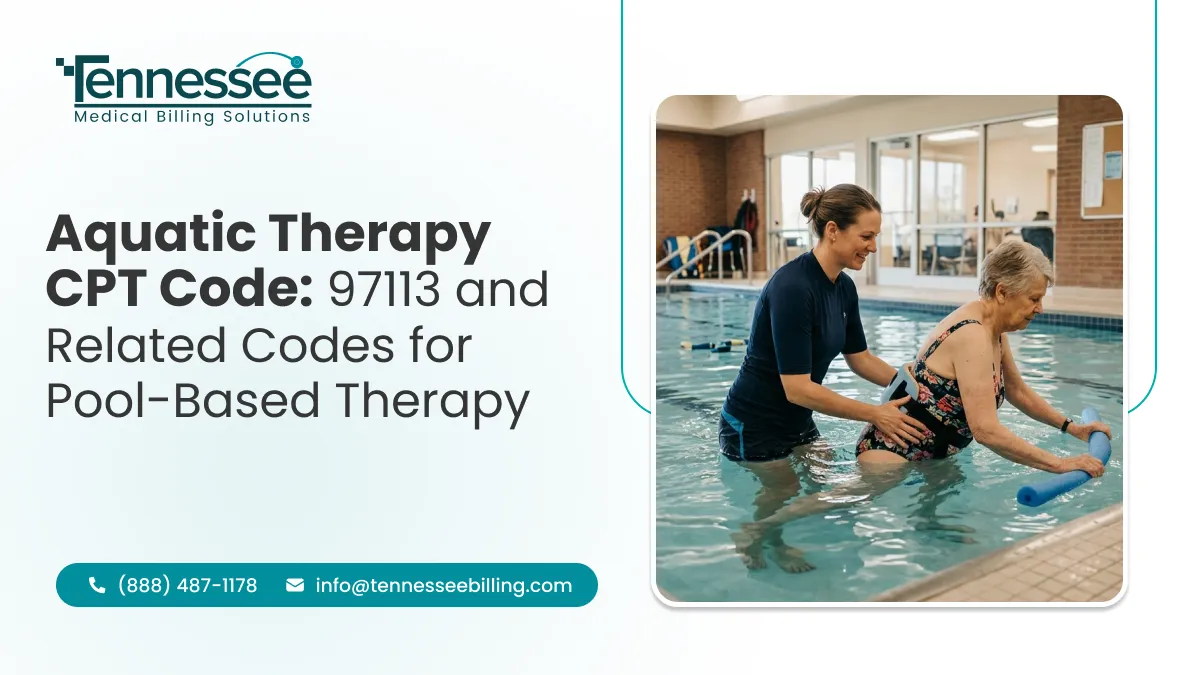
The aquatic therapy CPT code is 97113. It reports therapeutic exercise performed in water, with a qualified provider working directly with one patient, in 15-minute units.
It is located in the medicine and rehabilitation part of CPT near land-based codes such as 97110 and 97112. The environment is what makes them different. The setting is what separates them. The same exercise on a clinic floor is a different code.
Most aquatic claims go wrong on code selection, not on the number itself. Group classes get billed as 97113. Laps swum without the therapist are counted as treatment time. Pool exercise gets reported under land codes. Each one misstates the service.
Health insurers are watching pool-based care closely because it is sometimes hard to distinguish therapy from ordinary exercise. A clear claim starts with knowing which CPT codes belong to therapy and which CPT codes must not be used during the aquatic therapy session.
The essential reference facts for 97113 billing.
In practice, 97113 covers skilled strengthening, range of motion, balance, and endurance work where buoyancy or reduced joint loading is the reason for treatment.
Pool access, memberships, independent swimming and fitness classes are not covered. No CPT code pays for the pool itself. Confirm the descriptor wording in your licensed CPT code set because the text belongs to the AMA.
97113 is the core code, but a pool-based episode of care usually involves several others.
| Code | What it reports | Role in aquatic billing |
| 97161–97163 | PT evaluation (low, moderate, high complexity) | Opens the episode; where the reason for water is documented |
| 97164 | PT re-evaluation | Only when clinically justified |
| 97113 | Aquatic therapy with therapeutic exercises | Core treatment code |
| 97150 | Group therapeutic procedures (2+ patients) | Only where the payer covers group pool therapy |
| 97110 | Therapeutic exercise (land) | Land minutes only |
| 97112, 97116, 97530 | Neuromuscular re-education, gait training, therapeutic activities | Land minutes; payer rules on pool use vary |
| 97140 | Manual therapy | Distinct hands-on techniques only |
| 97022 | Whirlpool | A modality, not pool exercise |
| 97139 / 97039 | Unlisted therapeutic procedure / modality | Only when no defined code fits |
OT practices use the same treatment codes with the OT evaluation codes (97165–97168) and the GO modifier.
97113 applies when skilled therapy is delivered in the water and the provider is working directly with the patient.
Use CPT 97113 when
Consider the patient who’s six weeks after a total knee replacement and still cannot tolerate weight on the ground. The physical therapist spends forty minutes in the pool guiding graded knee flexion, weight shifts and gait drills. Contact is continuous. The note explains why land work is not yet possible. This supports code 97113. Allows three units, under Medicare’s eight‑minute rule if no other timed service was billed.
Selection follows three questions: how many patients, where the work happened, and what else was separately done.
One patient with continuous provider contact points to 97113. Two or more patients treated together points to 97150, if the payer allows it.
Exercise performed in the pool is reported as 97113. Exercise performed on land goes under its own code for its own minutes. In a mixed visit, track the two separately.
An evaluation, or a distinct manual technique such as joint mobilization, may be reportable in addition. Guiding a limb during pool exercise is part of 97113 and is not manual therapy.
Aquatic therapy notes have to show two things: the service was skilled, and the water was necessary.
The note should include
A short note is rarely what sinks these claims. The usual gap is the missing “why water.” Without it, a reviewer can ask why the same work couldn’t have been done on land, and the claim reads as general exercise.
Payment depends on the fee schedule, the payer’s unit-counting method, and who furnished the service.
| Factor | What to know |
| Medicare unit counting | 8-minute rule applied to total timed minutes in the visit |
| Medicare rate | Look up the current-year amount for your locality in the CMS Physician Fee Schedule |
| Assistant-furnished care | CQ/CO payment differential applies under Medicare |
| Commercial payers | Contract-specific; some use a midpoint rule, visit caps, or prior authorization |
Medicare converts total timed minutes to units this way: 8–22 minutes is 1 unit, 23–37 is 2, 38–52 is 3, 53–67 is 4, and 68–82 is 5. Only direct-contact minutes count toward the total.
Only the modifiers that come up on aquatic therapy claims.
| Modifier | When it applies |
| GP / GO / GN | Required on Medicare therapy claims; identifies PT, OT, or speech-language pathology plan of care |
| CQ / CO | Service furnished in whole or part by a PT assistant (CQ) or OT assistant (CO) |
| KX | Services above the annual Medicare threshold are medically necessary and documented |
| 59 / X-modifiers | Only when an NCCI edit requires it and the record shows a distinct service |
| 96 / 97 | Habilitative or rehabilitative, where a commercial plan requires it |
Adding 59 to push 97113 through alongside another code without checking the NCCI edit or the notes a compliance concern. The documentation has to show two services.
The boundary is the setting and the number of patients treated.
Choose 97113 when one patient receives skilled exercise in the water. Choose 97110 when the same kind of work happens on land. Choose 97150 when a therapist is treating a group and the payer covers it.
If the session has no therapist directing the exercise, none of the three applies.
Five errors drive most aquatic therapy denials and audit findings.
When several patients work through a routine together, the service is group therapy. Reporting it as individual care misstates what was delivered.
Minutes where the patient swims or exercises alone don’t qualify. Only time with direct provider involvement counts toward units.
The exercise may be identical to the land version. The setting is not, and 97113 exists for it.
Support and handling during an exercise are part of 97113. Reserve 97140 for distinct manual techniques with their own documented time.
Units that exceed recorded time are a common audit finding. Run a unit check against the note before submitting.
Here are some commonly asked questions about the aquatic therapy CPT code:
What is the CPT code for aquatic therapy?
It reports aquatic therapy with therapeutic exercises, in 15-minute units, with direct one-on-one provider contact.
Is there more than one CPT code for aquatic therapy?
97113 is the only treatment code written for the aquatic setting. Practices also use evaluation codes (97161–97164), 97150 for covered group sessions, and land codes for land work in the same visit.
Can 97113 be billed for a group aquatic class?
No. Group therapy is reported with 97150 where the payer covers it. Wellness and fitness classes are not insurance claims.
Does Medicare cover aquatic therapy?
It can, when the service is reasonable and necessary, delivered under a certified plan of care, and furnished by a qualified provider. Local MAC policies may add conditions.
Is whirlpool therapy the same as aquatic therapy?
No. Whirlpool is reported with 97022, a modality code, and is not used for pool exercise.
Can 97113 and 97110 be billed on the same day?
Yes, when each service was performed on its own setting, with its own documented minutes. Check NCCI edits and payer policy for the pair.