ICD-10 Codes for OCD: F42.9 Coding & Billing Guide
September 29, 2026
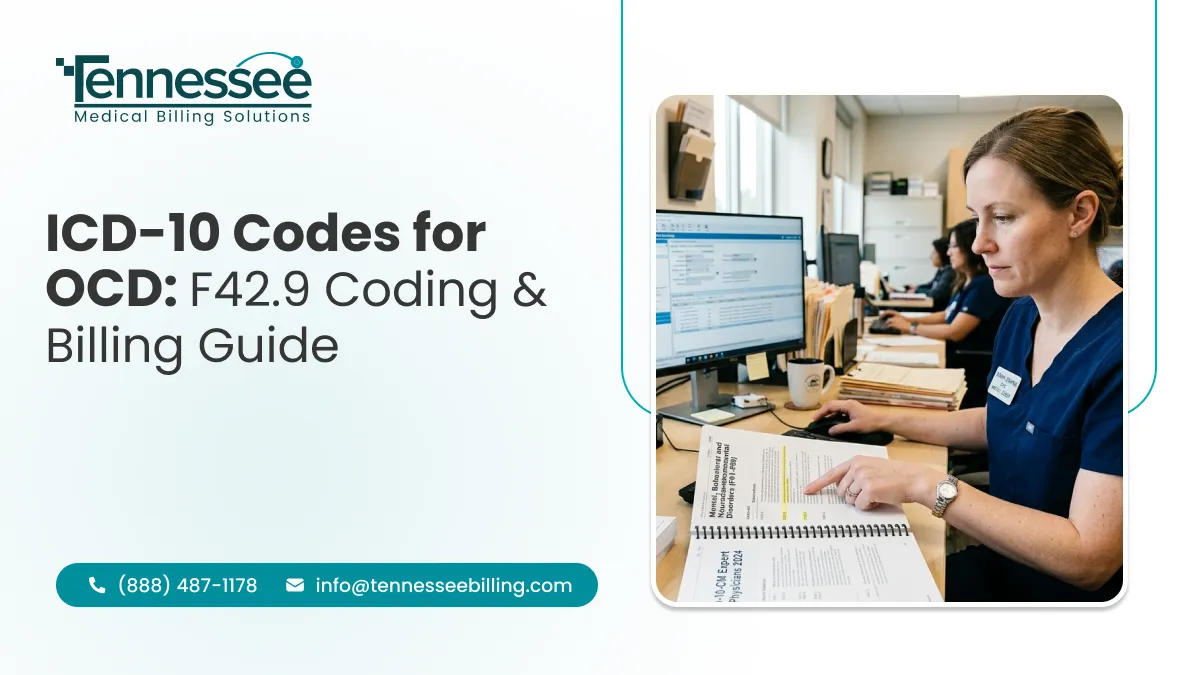
OCD is rarely the same from one patient to the next. Some patients may check locks or appliances for hours on end. Others may have obsessive thoughts, compulsive washing or rituals they cannot control. But regarding billing, symptoms tell only half the story. ICD-10-CM code selection is based on the documented diagnosis of the provider.
A claim can create problems when F42.9 is used even though the record supports a more specific diagnosis. The opposite situation is more concerning: assigning OCD when the provider never documented it. The diagnosis must also be consistent with the service provided, whether that service was a psychiatric evaluation, psychotherapy, medication management or some other behavioral health service.
This guide covers ICD-10 codes for OCD, including F42.9, related F42 codes, documentation considerations, common CPT codes, and billing issues that can affect claim accuracy.
In U.S. ICD-10-CM, F42.9 represents obsessive-compulsive disorder, unspecified. This code fits when the provider documents OCD but the record does not contain enough detail to support a more specific diagnosis within the F42 category.
There are several other codes under F42. The category also covers mixed obsessional thoughts and acts, hoarding disorder, excoriation disorder, and other obsessive-compulsive disorder.
So, a search for an icd 10 code for ocd should be treated as a starting point, not the final coding decision. The provider’s assessment needs to be checked before the claim is coded. What appears in the clinical record should determine the code—not simply the most common OCD code in a billing system.
If the provider documents “OCD, unspecified,” the ICD-10-CM code is F42.9.
When the provider identifies a more specific diagnosis represented elsewhere in the F42 category, the more specific code should be used when the documentation supports it.
The date of service matters when selecting the ICD-10-CM code set for a U.S. encounter.
For FY2027, the applicable code set covers encounters from October 1, 2026, through September 30, 2027. CMS publishes the FY2027 ICD-10-CM files and guidelines for this period.
This becomes especially relevant when billing teams work older accounts. An ICD-10 reference saved in an EHR, spreadsheet, encoder, or internal cheat sheet may not reflect the code set that applied on the actual date of service.
For encounters on or after October 1, 2026, review the FY2027 code set and guidelines. Earlier encounters should be reviewed using the code set that applied to their respective dates of service.
When reviewing documentation for OCD-related conditions, these are the principal ICD-10-CM codes you may encounter:
| Condition or Scenario | ICD-10-CM Code | Official Description |
|---|---|---|
| Mixed obsessional thoughts and acts | F42.2 | Mixed obsessional thoughts and acts |
| Hoarding disorder | F42.3 | Hoarding disorder |
| Excoriation disorder | F42.4 | Excoriation (skin-picking) disorder |
| Other specified OCD | F42.8 | Other obsessive-compulsive disorder |
| Unspecified OCD | F42.9 | Obsessive-compulsive disorder, unspecified |
CMS psychiatric billing materials list these F42 diagnosis codes.
It is easy to overlook the difference between these two. F42 is the broader category, while F42.9 is the specific code for obsessive-compulsive disorder, unspecified.
When a complete reportable ICD-10-CM code is required, do not stop at the three-character category. Review the Alphabetic Index and Tabular List, then choose the level of specificity supported by the provider’s documentation.
F42.9 means “Obsessive-compulsive disorder, unspecified.”
It may be appropriate when the provider documents OCD but does not identify a more specific condition within the F42 category.
For example:
Assessment: Obsessive-compulsive disorder, unspecified.
Plan: Continue psychotherapy and medication management.
If nothing else in the record supports a more specific F42 diagnosis, F42.9 may be appropriate. What should be avoided is treating F42.9 as the automatic answer whenever “OCD” appears in the assessment. If the provider documents a specific diagnosis that maps to another reportable F42 code, that documentation should be reviewed first.
| 01 |
Begin Here
Start With the Provider’s Assessment
|
| 02 |
Check Specificity
Look for a Specific F42 Diagnosis
|
| 03 |
Avoid Assumptions
Don’t Turn Symptoms Into a Diagnosis
|
| 04 |
Review the Encounter
Read the Assessment Together With the Treatment Plan
|
| 05 |
Final Check
Keep ICD-10-CM and CPT Separate
|
The provider’s assessment is where the coding review should begin.
Patients may say they are washing their hands all the time, having bad thoughts, checking things over and over, or being afraid of being dirty. Those details can help explain the clinical picture but do not allow the coder to make an independent diagnosis of OCD.
The coding team’s role is to report the diagnosis supported by the provider’s documentation.
Once OCD has been documented, check whether the provider has gone into greater diagnostic detail.
The relevant codes include:
F42.9 should not be selected simply because it is the first result returned during a search for an icd 10 code for ocd. The medical record should drive the decision.
Consider a note that says:
Patient reports intrusive thoughts and checks the front door repeatedly before leaving home.
That description may point toward a possible clinical concern, but the coder cannot turn those symptoms into an OCD diagnosis if the provider has not documented one.
When the assessment is unclear, use the organization’s compliant provider-query process rather than making the clinical decision yourself.
The diagnosis should fit what actually happened during the encounter.
When reviewing the record, look for:
A diagnosis listed on a problem list may not tell you what was addressed during that particular visit. The assessment, treatment, and plan provide the fuller picture.
This distinction is simple but important:
ICD-10-CM describes the diagnosis. CPT describes the service.
For example, a psychiatrist may provide psychotherapy to a patient with OCD. The OCD diagnosis is reported with the appropriate ICD-10-CM code, while the psychotherapy service is reported separately with the CPT code supported by the encounter.
The diagnosis does not become the CPT code.
A useful OCD note does not need to be written specifically for the billing team. It needs to clearly show what the provider evaluated, diagnosed, and treated.
| Documentation item | What the billing team needs to see |
| Confirmed diagnosis | Provider’s current diagnostic assessment |
| Specificity | Specific OCD diagnosis when clinically established |
| Current status | Whether the condition is active, improving, worsening, or otherwise addressed |
| Relevant symptoms/findings | Clinical information supporting the provider’s assessment |
| Functional impact | Documented impact when relevant to the clinical picture |
| Treatment provided | Psychotherapy, medication management, evaluation, or other service actually performed |
| Response to treatment | Progress, lack of improvement, or treatment response when addressed |
| Medical necessity | Documentation supporting why the service was provided |
| Plan | Follow-up, medication changes, therapy plan, or other documented next steps |
OCD follow-up. Continue medication.
The diagnosis is present, but the note leaves many questions about what was actually reviewed or treated during the visit.
OCD remains active. Patients report persistent intrusive contamination thoughts and repeated handwashing that continue to interfere with daily activities. Symptoms were reviewed and the current treatment plan was continued.
Now the diagnosis is tied more clearly to the patient’s current symptoms and the work addressed during the encounter.
OCD remains active with persistent contamination-related obsessions and repetitive washing rituals. The patient reports fewer episodes since the previous visit but continues to avoid certain activities because of contamination concerns. Psychotherapy addressed the documented symptoms and treatment goals. Medication response and adverse effects were reviewed, and the treatment plan was updated.
Providers should document what actually happened during the encounter. Extra details should never be added simply to make a claim appear more billable.
There is no single CPT code for an OCD visit. The appropriate code depends on the service the provider actually performed.
CMS lists the following among commonly used mental-health CPT codes:
| Service | CPT code | General billing purpose |
| Psychiatric diagnostic evaluation | 90791 | Diagnostic psychiatric evaluation |
| Psychiatric diagnostic evaluation with medical services | 90792 | Psychiatric diagnostic evaluation that includes medical services |
| Psychotherapy, 30 minutes | 90832 | Individual psychotherapy |
| Psychotherapy with E/M, 30 minutes | 90833 | Psychotherapy reported with an E/M service |
| Psychotherapy, 45 minutes | 90834 | Individual psychotherapy |
| Psychotherapy with E/M, 45 minutes | 90836 | Psychotherapy reported with an E/M service |
| Psychotherapy, 60 minutes | 90837 | Individual psychotherapy |
| Psychotherapy with E/M, 60 minutes | 90838 | Psychotherapy reported with an E/M service |
| Group psychotherapy | 90853 | Group psychotherapy |
| Interactive complexity | 90785 | Add-on when applicable requirements are met |
| Crisis psychotherapy, first 60 minutes | 90839 | Psychotherapy for crisis |
| Crisis psychotherapy, each additional 30 minutes | 90840 | Add-on to 90839 when applicable |
CMS explains that 90833, 90836, and 90838 are add-on psychotherapy codes used with qualifying E/M services. Codes 90791 and 90792 are used for psychiatric diagnostic evaluations.
Time-based psychotherapy codes need documentation that supports the service reported. For Medicare billing, CMS provides time-related guidance for 90832, 90834, and 90837 and expects the medical record to support the service billed.
For instance, writing “45-minute therapy” in a note does not, by itself, resolve whether the documentation supports the service reported.
Crisis psychotherapy follows its own reporting requirements. CMS identifies 90839 for the first 60 minutes and 90840 for each additional 30 minutes when applicable. These crisis codes also have restrictions involving certain other psychiatric services, including 90791, 90792, and 90832–90838, when reported for the same service.
Certain Medicare non-facility settings may also use G0017 and G0018 for psychotherapy for crisis. These are HCPCS codes for the service, not OCD diagnosis codes.
| Documentation Scenario | Code / Approach | Billing Consideration |
|---|---|---|
| Provider documents excoriation disorder | F42.4 | Do not substitute unspecified OCD automatically |
| Provider documents another specified OCD diagnosis | F42.8 | Review the documentation for the specified condition |
| Patient reports compulsions but provider does not diagnose OCD | Do not independently assign F42 | Follow query procedures when clarification is necessary |
| Psychiatrist performs diagnostic evaluation | 90791 or 90792 + appropriate diagnosis | Select based on the service performed |
| Therapist performs 45-minute psychotherapy | 90834 + supported diagnosis | Documentation must support the reported service |
| Qualifying E/M plus psychotherapy | Appropriate E/M + 90833, 90836, or 90838 | Both components must meet applicable requirements |
| Crisis psychotherapy is provided | 90839/90840, when requirements are met | Separate crisis-service rules apply |
The relationship between diagnosis and service should remain clear: the provider documents the diagnosis, and the service performed determines the CPT code.
A screening questionnaire, clinical scale, symptom list, or similar assessment does not give the coder permission to establish OCD independently.
A screening tool may help the provider during the clinical assessment. The claim, however, still needs provider documentation supporting the diagnosis being reported.
For example, a screening result may suggest possible OCD while the provider documents:
“OCD not established; further evaluation planned.”
The coder should not simply turn that statement into F42.9.
If the record contains conflicting or incomplete information, a compliant provider query may be appropriate. The purpose is to clarify what the provider meant—not to lead the provider toward a diagnosis because it could change reimbursement.
The rules for uncertain diagnoses depend on the setting.
For outpatient coding, terms such as probable, suspected, questionable, rule out, or possible are not coded as confirmed diagnoses.
Under the FY2027 Official Guidelines, coders should report the highest degree of certainty known for the encounter. Depending on the record, that may mean reporting symptoms, signs, abnormal test results, or another documented reason for the visit.
For example:
Assessment: Possible OCD; diagnostic evaluation ongoing.
That wording should not automatically become F42.9 simply because OCD is being considered.
Qualifying inpatient admissions follow a different rule.
According to the inpatient uncertain-diagnosis guideline, some diagnoses documented at discharge as probable, suspected, likely, questionable, possible, or similar may be coded as if they existed or were established.
This difference matters for organizations handling both outpatient behavioral-health encounters and inpatient psychiatric admissions.
|
01
Defaulting Every OCD Claim to F42.9
|
02
Coding the Patient’s Words Instead of the Provider’s Diagnosis
|
03
Treating F42 and F42.9 as Interchangeable
|
|
|
04
Choosing CPT Based on the Diagnosis
|
05
Ignoring Psychotherapy Documentation
|
06
Treating an Uncertain Diagnosis as Confirmed
|
|
|
|||
F42.9 has a legitimate place in OCD coding, but it should not become a shortcut. If the provider documents a more specific diagnosis represented by another F42 code, review that documentation before using the unspecified code.
A patient saying “I think I have OCD” is not the same as a provider documenting OCD. The coder should not turn the patient’s description, screening score, or symptom pattern into a confirmed psychiatric diagnosis.
F42 is the category. F42.9 is the specific code for obsessive-compulsive disorder, unspecified.
That distinction matters when a billing system, encoder, or claim editor requires a complete reportable ICD-10-CM code.
A patient with OCD could receive a psychiatric evaluation, individual psychotherapy, group psychotherapy, medication management with E/M, or crisis treatment.
The diagnosis does not tell you which CPT service was performed. The documentation of the encounter does.
When a time-based psychotherapy code is reported, the record needs to support the service and applicable time requirements. CMS provides specific Medicare guidance for these services.
“Rule out OCD” and “OCD” are not equivalent for outpatient coding.
Read the provider’s exact assessment before assigning F42.9.
ICD-10-CM is updated each year. For FY2027, CMS identifies October 1, 2026, through September 30, 2027, as the applicable encounter period.
An older claim may therefore need a different code-set review than a current encounter.
Before submitting an OCD claim, verify the provider’s diagnosis, choose the most specific supported F42 code, and match the CPT to the service performed. Check documentation, medical necessity, date-specific coding rules, and payer requirements to avoid preventable denials.
The current diagnosis should not be buried somewhere in several pages of narrative. A clear assessment and plan gives the billing team a better view of what the provider actually evaluated and treated.
During claim review, ask two separate questions:
Diagnosis: Does the ICD-10-CM code match what the provider documented?
Service: Does the CPT code describe what the provider actually performed?
Looking at these separately can uncover mistakes that might otherwise blend together during a general claim review.
A high percentage of F42.9 claims does not automatically mean the practice is coding incorrectly. Some patients genuinely have unspecified OCD.
It is still worth reviewing repeated use of F42.9. If providers routinely document specific diagnoses while claims continue to leave the practice with F42.9, the problem may be happening during code selection rather than in the clinical note.
A correct diagnosis code does not guarantee payment.
Medical necessity, authorization, provider eligibility, CPT reporting rules, telehealth requirements, modifiers, coverage policies, and payer-specific requirements can all affect claim adjudication.
When the documentation does not provide enough information for accurate code assignment, a compliant query is preferable to a coding assumption.
The provider remains responsible for the clinical diagnosis. The coding team’s role is to translate that documented diagnosis into the appropriate code.
| Verification Item | Status |
|---|---|
| Provider documented the diagnosis | ✓ |
| Diagnosis reflects the current encounter | ✓ |
| Most specific supported F42 code selected | ✓ |
| F42.9 used only when unspecified OCD is supported | ✓ |
| Symptoms were not converted into a diagnosis by the coder | ✓ |
| CPT reflects the actual service performed | ✓ |
| Psychotherapy time is supported when applicable | ✓ |
| E/M and psychotherapy reporting rules were reviewed | ✓ |
| Crisis-service rules were reviewed when applicable | ✓ |
| Medical necessity is supported | ✓ |
| Code set matches the date of service | ✓ |
| Payer-specific requirements were checked | ✓ |
| Documentation supports the submitted claim | ✓ |
A good claim review should catch these issues while the claim is still in the billing queue, rather than after the payer sends it back.
What CPT code is used for OCD treatment?
There is no single CPT code specifically for OCD treatment. Depending on the service provided, commonly used psychiatric codes include 90791, 90792, 90832, 90834, 90837, 90833, 90836, 90838, and 90853. Crisis psychotherapy may involve 90839 and 90840 when applicable.
Can F42.9 be reported with psychotherapy?
Yes, when the provider has documented OCD and the psychotherapy service is otherwise reportable and medically necessary. F42.9 identifies the diagnosis, while the appropriate psychotherapy CPT code identifies the service.
Can a coder assign OCD from a screening score?
No. A coder should not independently establish OCD from a screening score or symptom pattern. The provider’s documented diagnosis and the applicable ICD-10-CM guidelines should support the code.
How is a possible OCD diagnosis handled in an outpatient encounter?
A possible or suspected OCD diagnosis is not coded as confirmed in an outpatient encounter. The coder should report the highest degree of certainty supported by the documentation under the applicable outpatient coding guideline.
Does a correct OCD diagnosis code guarantee payment?
No. Accurate diagnosis coding is only one part of claim adjudication. CPT selection, medical necessity, authorization, payer policy, provider eligibility, documentation, and other billing requirements can also affect payment.
When should a provider be queried?
A provider query may be appropriate when documentation is incomplete, conflicting, or unclear enough to prevent accurate code assignment. The query should seek clarification without suggesting a diagnosis or code simply to influence reimbursement.
“OCD” may look simple in a medical record, but the coding decision still comes down to the provider’s documentation. For U.S. claims, F42.9 represents unspecified OCD, while other F42 codes apply when the provider documents a more specific diagnosis.
A clean claim also depends on keeping the diagnosis and service connected without treating them as the same thing. ICD-10-CM identifies the condition; CPT describes the service. When the documentation supports the diagnosis, the appropriate date-specific code set is used, and payer requirements are checked, the billing team has a stronger foundation for reducing avoidable rework, denials, and audit concerns.
|
Behavioral Health Billing
Need Help Reviewing OCD Claims?From ICD-10-CM diagnosis selection to CPT reporting and payer requirements, Tennessee Billing can help your practice review behavioral health claims for accuracy and reduce avoidable billing rework. |
Get Billing Support |